Cathead Biscuits (Southern)
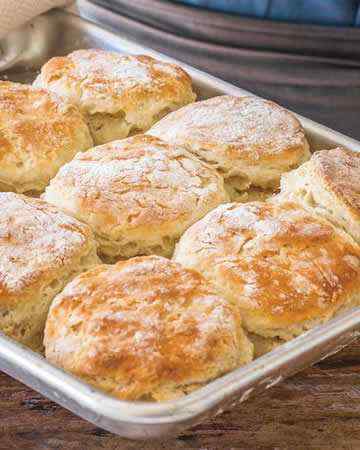 These giant buttermilk biscuits are golden brown and slightly crisp outside. They're light, soft, and airy inside. This recipe for cathead biscuits come from chef Virginia Willis, and was featured in her book Secrets of the Southern Table. Willis recalls her grandfather talking about cathead biscuits - biscuits as big as a cat’s head.
Her extra-large buttermilk biscuits are a rolled and cut-out biscuit, not a drop biscuit. Willis uses a 3½" round cutter. If the biscuits are baked close together, their sides will be tender. If the biscuits are baked farther apart, their sides will be crisp. Either way, their tops bake up golden brown, and the biscuits are light and airy inside. Enjoy them still warm from the oven.
What Are Cathead Biscuits?
Like so many foods, there are competing ideas about what makes a biscuit a cathead biscuit. Sure it needs to be large, that is not a matter of debate (though maybe not quite as big as a cat’s head). Where the controversy comes is about the type of biscuit. Some sources say cathead biscuits are drop biscuits, but Virginia’s recipe is one of the many that call a rolled and cut-out biscuit a cathead biscuit.
The Best Flour to Use for Biscuits:
Southern all-purpose flour is different to all-purpose flour in the rest of the country. It is milled from soft red winter wheat that has less gluten-forming protein. It is typically bleached, which makes it whiter, but this does not affect the protein. Willis says her family has always used White Lily flour, a staple across the South; another dependable Southern brand is Martha White.
If you don’t have access to those southern flours, do not substitute your usual all-purpose flour because most national brands are made with a combination of soft winter wheat and higher-protein hard summer wheat. They are higher in protein and develop more gluten, which is great for some baking, but not for biscuits. Rather, follow the recipe and make these cathead biscuits with cake flour (but be sure not to use self-rising cake flour).
4 cups White Lily or other Southern all-purpose flour, or cake flour (not self-rising)
2 Tbsp. baking powder
2 tsp. fine sea salt
8 Tbsp. (½ cup) butter, cold, cut into cubes
2 cups buttermilk
Preheat oven to 500°F (260°C/240°C fan, Gas Mark 10). Line a baking sheet with a silicone baking mat. (You can also bake the biscuits on an ungreased baking sheet.)
In a bowl, combine flour, baking powder, and salt. Using a pastry blender or two knives, cut butter into flour mixture until it resembles coarse meal.
Pour in buttermilk and mix until just barely combined. It will be a shaggy mass.
Food processor method: Pulse to combine flour, baking powder and salt. Add butter and pulse until it resembles coarse meal. Pour in buttermilk through feed tube and pulse until just barely combined.
Turn shaggy mass out onto a lightly floured surface. Knead lightly, using the heel of your hand to compress and push dough away from you, then fold it back over itself. Give dough a small turn and repeat four or five times.
You want to just barely activate the gluten, not overwork it.
Using a lightly floured rolling pin, roll out dough 1" thick. Using a 3½" round cutter dipped in flour, cut out rounds.
Be sure to press the cutter straight down without twisting so the biscuits will rise evenly when baked.
Place biscuits on prepared sheet. (If biscuits are baked close together, sides will be tender. If biscuits are baked farther apart, sides will be crisp.)
Reroll scraps once. (Do not simply roll them into a ball; this will create a knot of gluten strands. Instead, place the pieces one on top of the other in layers, then roll out dough and cut out more rounds.)
Bake until golden brown, 10-12 minutes. Transfer to a rack to cool just slightly. Serve warm.
Cook's Notes:
- Storage: Cathead biscuits are best enjoyed on the day they are made. If you have any leftovers, store them in an airtight container and use them the following day.
- Reheating Leftover Biscuits: Preheat the oven to 350°F (180°C/160°C fan, Gas Mark 4). Place the biscuits on a wire rack set over a baking sheet and bake for 5-6 minutes.
- Freezing: Cool the biscuits completely, then wrap biscuits in foil and place in a freezer bag or airtight container. Freeze for up to three months.
Frequently Asked Questions:
- Do biscuits have to be made by hand? Traditionally biscuits were mixed by hand but our cathead biscuits can be made using the food processor method outlined above.
- Why are my biscuits flat and dense? There are a number of reasons why your biscuits are flat and dense. Using the wrong flour, a flour with too much protein, is one. Overmixing the dough, which also promotes gluten, is another. Rerolling the dough more than once is another way of creating too much gluten and can also create tough biscuits.