Brioche Crown (French Brioche à Tête)
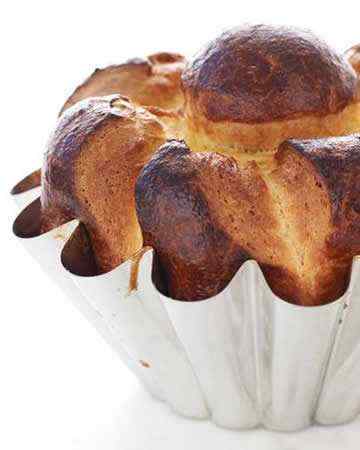 Brioche à tête, also known as brioche Parisienne, is a French pastry consisting of a round loaf of brioche with a smaller ball of dough on top, forming a "head". These eye-catching breads are rich and tender. Brioche comes in several forms, but the coolest shape has to be the brioche à tête. This classic French brioche dough is shaped into balls and baked in a fluted tin. The final shape is a rounded dome with a smaller domed head (tête) on top.
This brioche recipe produces gorgeous, fluted loaves known as brioche à tête, which refers to the bread's head-like shape ("tête" translates to "head" in French). An enriched dough containing milk, eggs and butter, the bread is rich tasting with a fluffy, tender texture and a deeply browned exterior. The dough goes through a few proofing stages, both at room temperature and in the fridge, which helps it to develop its signature yeasty flavour and unbelievably airy texture. Shaping the loaves may look complicated, but it only takes a bit of patience - and a sharp pair of scissors - to form each eye-catching bread.
5 Tbsp. + 1 Tbsp. milk, lukewarm (100-115°F)
½ oz fresh yeast or ¼ oz ???
1 lb 2 oz all-purpose flour, unbleached
1 Tbsp. coarse sea salt
6 large eggs
1 large egg yolk
1½ cups (3 sticks) butter, slightly softened
¼ cup superfine sugar
nonstick cooking spray
1 Tbsp. milk
nonstick cooking spray
Place lukewarm milk and yeast in a small bowl; stir to dissolve.
If using active dry yeast, let milk-yeast mixture sit until foamy, about 5 minutes, before adding to the flour mixture in step 2.
Place flour, salt and eggs in the bowl of an electric mixer fitted with dough hook attachment; add yeast mixture and mix on low speed to combine and knead, about 5 minutes.
Scrape down sides of bowl with a spatula; knead on medium speed until smooth and elastic, about 10 minutes.
In a large bowl, mix together butter and sugar. Add a few small pieces of butter mixture to dough; with the mixer on low, add remaining butter mixture, a little bit at a time.
When all the butter mixture has been added, increase speed and continue mixing until smooth, shiny, comes away from the sides of the bowl and is elastic, 6-8 minutes.
Butter a large bowl, transfer dough to prepared bowl and cover with plastic wrap; let stand in a warm place until doubled in volume, about 2 hours.
Lift dough from bowl and drop back into bowl to deflate; repeat process once or twice. Cover bowl and transfer to refrigerator to chill for at least 8 hours and up to overnight.
Butter two brioche molds that are 8" across the top and 3½" across the bottom. Divide dough in half. Cut off one-quarter of each piece of dough; you should have two pieces that are about 15 oz each and two pieces that are about 5 oz each.
Shape the large pieces into balls and place one piece in the bottom of each mold. Press two fingers into the center of each to make a deep indentation.
Shape the small pieces of dough into a ball and roll each at an angle into an elongated oval. Lightly flour middle and index fingers on one hand and gently press the narrow ends of the ovals into the indentation in the large ball so that only the top parts are left visible.
In a small bowl, whisk together egg yolk and remaining 1 Tbsp. milk. Brush dough with egg yolk mixture, reserving remaining.
Spray two pieces of plastic wrap with nonstick cooking spray; cover dough in both molds, cooking spray-side down and let stand in a warm place until doubled in volume, 1½-2 hours.
Preheat an oven to 400°F (200°C/180°C fan, Gas Mark 6).
Working from the outside inward, brush each brioche very lightly with reserved egg yolk mixture. Using a pair of very sharp wet scissors, make five 1¼" deep cuts around the large pieces of dough on an angle.
Transfer molds to oven and bake until brioche just begins to turn golden, about 15 minutes.
Reduce temperature to 350°F (180°C/160°C fan, Gas Mark 4) and continue baking until deep golden brown and internal temperature reaches 205°F on an instant-read thermometer, 20-25 minutes more.
Let cool 5 minutes, then unmold:
Remove from oven and let brioche cool in mold for 5 minutes. Unmold onto a wire rack and let cool completely.
Makes 16 servings or 2 large brioches.
Equipment Needed for Brioche à Tête:
- Stand-Mixer: We strongly recommend using a stand-mixer fitted with a dough hook attachment to knead this bread. The dough will require nearly 20 minutes of mixing time using a stand-mixer and even longer than that with a hand-held mixer. Using a stand-mixer will also free up your hands to add the butter-sugar mixture bit by bit in step four.
- Brioche Molds: You'll need two fluted brioche molds that measure eight” across the top and three and one-half” across the bottom. You can find these at specialty cookware stores and online. If you can't locate brioche molds, consider making our equally delicious recipe for brioche loaves instead.
- Pastry Brush: To achieve the deeply browned crust that takes these loaves over the top, you'll want to brush them two separate times with a mixture of egg yolk and milk. On the second application, it's especially important to use a very light hand to keep the puffed dough from deflating. A natural or silicone brush will work equally well here.
- Fresh vs. Active Dry Yeast: You can use either fresh or active dry yeast for this recipe. While it used to be more widely available, fresh yeast, which needs to be refrigerated and has a short shelf life, is now mostly sold on a seasonal basis, if at all. Active dry yeast is readily available. It needs to be combined with a warm liquid - in this case milk - and left to sit for a few minutes before being added to recipes. It can be stored at room temperature but will last much longer if refrigerated or frozen.