Yorkshire Pudding (English)
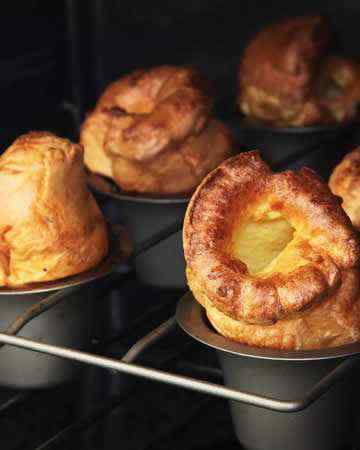 These traditional English gems are called puddings, but really they are eggy rolls without the yeast. The secret to making Yorkshires or Yorkies (as they are known in the UK) is to pour well rested, batter into slightly smoking hot fat and put immediately back into a really hot oven. It is as simple as that. Yorkshire Puddings are a classic British recipe and one of the major components of England's national dish, Roast Beef and Yorkshire Puddings, a regional dish with national (and international) appeal. These little puds can be served with any roast meal and go especially well with gravy.
Printed recipes for Yorkshire pudding go back as far as the mid-18th century, and the dish likely existed long before that. It's simple - almost primal - in its ingredients and process: Mix together milk, eggs, and flour with a pinch of salt to form a batter ("as for pancakes," according to the 1937 cookbook The Whole Duty of A Woman), then pour the batter in a pan that has been greased with the drippings from a roast. Originally, that roast was mutton; these days, it's more likely beef.
A Yorkshire pudding works on the same principle as a French pâte a choux, the thin pastry used to make cream puffs, Parisian-style gnocchi, and gougères. Those recipes all start with a high-moisture dough and rely on the power of steam to puff and rise into their light, crisp final forms. Yorkshire puddings and popovers take the same concept to the extreme, using a batter that is so moist that it pours out like cream and puffs up to at least quadruple its volume.
4 large eggs, measured into a jug (7 oz; 200 g)
1 cup + 2 tsp. all-purpose flour, unbleached (5.25 oz; 150 g)
¾ cup whole milk (6 oz; 175 g)
½ tsp. kosher salt (2 g)
1 Tbsp. + 2 tsp. water (0.85 oz; 25 g)
½ cup beef/bacon drippings, lard, shortening or vegetable oil (100 mL)
Preheat an oven to 450°F (230°C). Adjust oven rack to center position. Divide drippings (or other fat) evenly between two 8" cast iron or oven-safe non-stick skillets, two 6-well popover tins, one 12-well standard muffin tin, or one 24-well mini muffin tin. Preheat in the oven until the fat is smoking hot, about 10-15 minutes.
Combine eggs, flour, milk, water, and salt in a medium bowl and whisk until a smooth batter is formed. Let batter rest at room temperature for at least 30 minutes. Alternatively, for best results, transfer to an airtight container and refrigerate batter overnight or for up to 3 days. Remove from refrigerator while you preheat the oven.
Transfer the pans or tins to a heat-proof surface (such as an aluminum baking sheet on your stovetop), and divide the batter evenly between every well (or between the two pans if using pans). The wells should be filled between ½ and ¾ of the way (if using pans, they should be filled about ¼ of the way). Immediately return to oven. Bake until the yorkshire puddings have just about quadrupled in volume, are deep brown all over, crisp to the touch, and sound hollow when tapped. Smaller ones will take about 15 minutes, popover- or skillet-sized ones will take around 25 minutes.
Serve immediately, or cool completely, transfer to a zipper-lock freezer bag, and freeze for up to 3 months. Reheat in a hot toaster oven before serving.
Makes 8 servings.
Cook's Notes:
- Yorkshire puddings come out best when the batter has been rested for at least one night; however, they can be cooked immediately after forming the batter if time requires it. Form the batter as directed in step 1 and immediately proceed to step 2 without refrigerating it.
- The quantity of batter doesn't divide easily into standard 6-well popover pans, but you can scale up the recipe by 50% in order to make a full 12 popovers instead of 8.
- A combination of milk and water gives the Yorkshire puddings extra rise and crispness. If using skim or low-fat milk, omit the water and increase amount of milk to 200 g (7 oz; 1 cup minus 2 Tbsp.).
- Warmer batter will create taller, crisper puddings with a more hollow core (I kind of like them this way), but colder batter will create denser puddings with a more distinct cup. If you are the type who likes to make a separate onion gravy to pour inside the puddings as a first course, colder batter might be better for you.
- Beef fat has more flavour than a neutral vegetable oil, but the choice of fat in your Yorkshire pudding can affect more than just flavour. It also has an effect on texture. Just like with deep frying, the more highly saturated your fat is (that is, the more solid it is at room temperature), the crisper your puddings come out. Puddings baked with vegetable oil will be limper than those baked with shortening, which will be limper than those baked with beef or pork fat.
- Another note about fat: As the batter rises, the fat tends to pool in the center. If you use plenty of fat, that pooled fat will weigh down the center of the puddings, creating a deeper cup shape. So for the deepest cupping, use plenty of fat, colder batter, and a slightly higher ratio of flour to liquid in your batter.
- Flour-to-Liquid Ratio: There is a vast range of liquid-to-flour ratios in Yorkshire pudding batter recipes online. Cloake's, for instance, calls for a hydration level of only 140% (that is, for 100g of flour, there are 140 g of liquid). The BBC recipe more than doubles that ratio with a hydration level of 285%. I found 140% to be far too low, with 200% hydration the bare minimum for a thin, pourable batter that rises dramatically.
- Make sure your guests are seated and ready a few minutes before your puddings come out of the oven. Yorkshire puddings are light, they are delicate, and they lose heat fast. Like time and tide, a Yorkshire pudding waits for no one, so you better be ready when it is.
Serving Yorkshire Pudding:
- In Yorkshire serving the pudding is traditionally with gravy as a starter dish followed by the meat and vegetables. More often smaller puddings cooked in muffin tins are served alongside meat and vegetables.
- Yorkshire pudding isn't reserved only for Sunday lunch. A large pudding filled with a meaty stew or chili is a dish in its own right.
- Cold left-over Yorkshire Puddings make a lovely snack with a little jam or honey.
- Yorkshire Puddings do not reheat well, becoming brittle and dry.
Nutritional Information:
Per serving: Calories 219, Fat 15g, Carbs 16g, Protein 6g