Roasted Red Pepper Pesto (Italian)
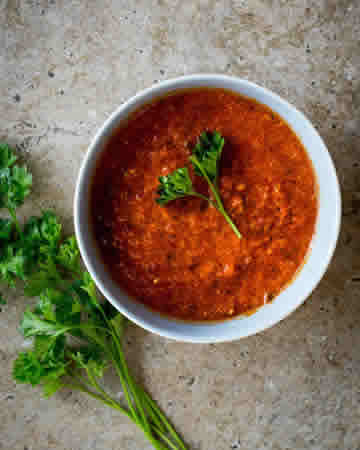 Roasted red pepper pesto is a contemporary Italian type of pesto, loved for its fabulous flavour. It's perfect with pasta, bruschetta, white meat, fish and also as a dip. This version combines roasted peppers with basil leaves, grated Parmigiano cheese, extra-virgin olive oil and walnuts, resulting in a delicious pesto.
3-4 red bell peppers washed, tops and seeds removed
1-2 small cloves garlic, peeled and cut into pieces
extra-virgin olive oil
3½ oz walnuts, shelled
1 handful fresh basil leaves
3½ oz Parmigiano Reggiano, freshly grated
sea salt
black pepper, freshly ground
fresh parsley chopped
Preheat the oven to 350°F (180°C/160°C fan, Gas Mark 4).
Place the cleaned red bell peppers on a baking tray lined with parchment paper. Drizzle lightly with olive oil and roast in the preheated oven for 20-25 minutes, or until the skins begin to blacken and blister. Remove from the oven and allow to cool slightly.
Peel the skin of the red peppers and cut into pieces.
In a blender, combine the walnuts and garlic. Pulse until the pieces are finely chopped. Add the roasted pepper pieces, basil leaves, half of the grated Parmigiano Reggiano cheese and a drizzle of olive oil. Pulse again until the mixture is evenly blended but retains some texture. If the pesto seems too dry, add a little more olive oil. Season with salt and black pepper, freshly ground. Now your red pepper pesto is ready.
Fill a large pot with water and bring to a boil. Add salt to the water and bring it to a boil again. Cook the pasta until al dente, according to the package instructions. Reserve a cup of the pasta cooking water, then drain the pasta and return it to the pot.
Add the roasted red pepper pesto to the cooked pasta. If the mixture seems too dry, add a bit of the reserved pasta cooking water to achieve the desired consistency. Mix well.
Serve the pasta immediately, topped with additional grated Parmigiano Reggiano cheese and chopped fresh parsley.
Makes 4 servings.
Cook’s Notes:
- You can also put this pesto on pizza, eat it on bread and add a little to grilled, baked or fried fish before serving.
- Alternatively, it can be used to fill pasta such as cannelloni if you add some ricotta to give it more bulk and of course you can eat it with other types of pasta. Using casarecce is not a rule. Fusilli are great too or tagliatelle and even gnocchi are a yummy pesto partner.
- This recipe can also be made with homemade casarecce.
Storage and Leftovers:
- For the Roasted Red Pepper Pesto Only:
- Refrigeration: Transfer the freshly made pesto to an airtight container and store it in the refrigerator. Properly stored, the pesto will remain fresh for up to 5 days.
- Freezing: To freeze pesto for longer-term storage, spoon it into a freezer bag, expel as much air as possible before sealing and lay it flat in the freezer. Pesto stored this way can be kept for up to three months. Thaw in the refrigerator overnight before use.
Storing the Pesto with Pasta:
- Storage: Allow any leftover pesto pasta to cool to room temperature before storing. Transfer the cooled pasta to an airtight container and store it in the refrigerator. It can be kept for up to 3 days.
- Reheating: For reheating, place the pasta in a microwave-safe container and cover it. Heat on medium power for two minutes, then stir to distribute the heat evenly. Continue heating in 30-60 second intervals, stirring between each, until the pasta is thoroughly heated.
- Alternatively, the pasta and pesto can be enjoyed cold from the refrigerator.
Frequently Asked Questions:
- What's the best way to peel roasted red peppers? While they are hot, place them in a sealed plastic bag or cover them with plastic wrap for about 15 minutes. The steam helps loosen the skin, making it easier to peel off with your fingers or a small knife.
- How can I adjust the thickness of the pesto? If the pesto is too thick, you can thin it by adding more olive oil until you reach the desired consistency. If it's too thin, pulse in more grated Parmesan or nuts to thicken it.
- Is this pesto vegetarian? This pesto can be made vegetarian by substituting the Parmigiano Reggiano with a vegetarian-friendly cheese alternative that does not use animal rennet. Traditional Italian Parmigiano Reggiano is made with animal rennet, which is not suitable for vegetarians.
- What else can I serve with red pepper pesto? You can also put this roasted red pepper pesto on pizza, eat it on bread and add a little to grilled, baked or fried fish before serving. Alternatively, it can be used to fill pasta such as cannelloni if you add some ricotta to give it more bulk and of course you can eat it with other types of pasta.