English Breakfast
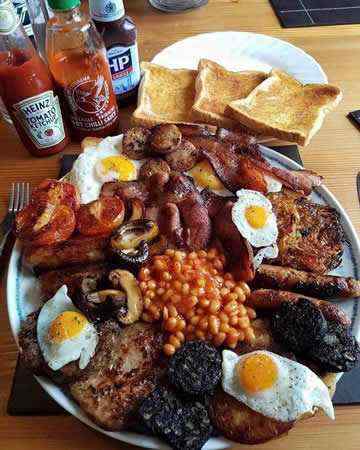 English breakfast (aka Full Breakfast, Full English or Fry-Up) is a dish that consists of a number of components such as back bacon, eggs, British sausage, baked beans, fried tomato, fried mushrooms, black pudding, and fried and toasted bread; however, these can vary depending on where you are in Great Britain. The Scottish will add potato scones, haggis, and oatcakes, while the Welsh may include laver bread or cakes and perhaps Penclawdd cockle. Irish on the other hand will add in white pudding, Irish soda bread, and Irish potato cake. Traditionally, this dish also included things like bone marrow, pork crackling, and a huge pork chop, and baked beans were always homemade. Even though the eggs can be fried, scrambled or poached, the majority of the ingredients are fried; hence the dish is colloquially known as the fry-up. English breakfast is a staple breakfast dish that most Brits will eat for the weekend as a sort of comfort food, although it can also be eaten for any meal of the day. It is typically served with tea and freshly squeezed orange juice.
British breakfast is a tradition that was started by the English gentry and dates back to the early 1300s. They were not only adamant about preserving the traditions of the traditional English country lifestyle, which also included country cuisine, but also used breakfast as a way to display wealth by showcasing an array of versatile foods and ingredients produced on their estates. During the Victorian era, the social class of gentry was in decline, while the social class made up of merchants, industrialists and businessmen was on the rise. Victorians did not only look up to gentry as a sort of an ideal to aspire to but consequently adopted many of their habits and traditions. They not only elevated and refined breakfast but also standardized the ingredients and invented what we today know as the full English breakfast. During the Industrial Revolution, the dish became a staple of the working classes, and its popularity reached a peak in the 1950s when nearly half of the Brits would start their day with a full English breakfast. The first recipes for the dish appeared around 1840, but the ingredients were not fixed and varied from recipe to recipe.
For this recipe to be a success, every component of the dish has to be served hot. When cooked, keep sausages, mushrooms, bacon, and tomato in the warm oven, then arrange them on a warm platter when ready to serve.
2 pork sausages
1 tomato
2 Tbsp. butter
2 rashers bacon
3.9 oz mushrooms (110 g)
1 (7.8 oz) can baked beans (220 g)
6 oz black pudding, sliced (170 g)
1 large egg
2 slices white or brown bread
sea salt
black pepper, freshly cracked
1 sprig fresh parsley
Set the oven to preheat to 425°F (220°C/200°C fan, Gas Mark 7).
Place a pan over medium heat and once it has warmed, brown the sausages on every side, then cook them for five minutes. Next, put them in a baking dish and bake for 10 minutes in the oven.
With a knife make a cross on the bottom of the tomato, then place in the baking tray together with the sausages, cross side up. Bake the tomato and the sausages for 10 minutes, then turn the heat off and leave them inside the oven, so they remain warm.
In the same frying pan in which you've fried the sausages, first melt a Tbsp. of butter, then fry mushrooms, bacon and blood pudding over high heat for 7 minutes. Once the mushrooms have softened, and the bacon is crispy transfer them to the oven, so they keep warm.
Add the beans to a small saucepan and cook over medium heat, stirring constantly.
Lastly, fry the egg, taking care that the yolk does not break and toast the bread, then spread the remaining butter over the toast.
Arrange the ingredients - sausages, bacon, blood pudding, beans, tomato, mushrooms, fried egg, and toast - on a warm platter, then season with salt and pepper and serve.
Makes 1 serving.
Cook's Notes:
- Bacon: The traditional choice of bacon for Brits is back bacon that is part pork loin, part pork belly, which you can substitute with American (pork belly) and Canadian (pork loin). In case you’re grilling bacon, make cuts and slices in the meat and the fat, so that it does not curl up and cooks evenly.
- Sausage: The preferred choice of Brits is either Cumberland sausage or Lincolnshire sausage. The first is made of chopped pork and seasonings, while the second has coarsely ground meat instead of minced. To substitute, use any local sausage you have that is not too herby.
- Beans: Beans that are nowadays almost uniformly used are canned beans that are just shortly reheated, although a proper, more laborious, way would be to make your baked beans from scratch.
- Method: Although traditionally the majority of the components that make up the English breakfast are fried, they can also be grilled, except sausages which should always be fried.
- Extra Ingredients: To make the dish even more delicious, Brits like to add either ketchup (red sauce) or vinegary, brown HP sauce as condiments. In recipes, you can often come across hash browns, but they are not a traditional component of the dish.
- Serving: English breakfast is traditionally served with tea, but also with coffee or orange juice. Additionally, a slice of toast spread with butter and marmalade can also be served, but it is meant to be eaten after with a cup of tea.