Cheesecake (Basque Gâteau au Fromage Brûlé)
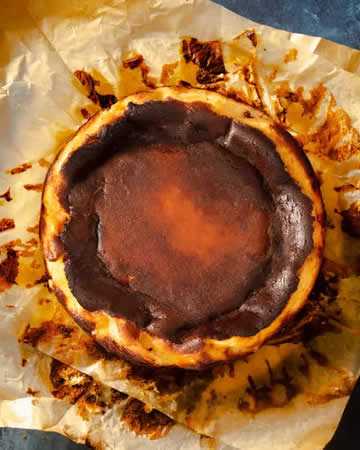 This cake is a deeply caramelized cousin of American cheesecake, inspired by the famous "tarta de queso" by Santiago Riviera of La Viña in Donostia-San Sebastián, Spain. Its defining features are a burnt top and barely set center, the result of baking the eggy cream cheese batter at a very high temperature. To achieve the perfect balance between the deeply browned top and creamy center, we chill the batter after mixing, and sprinkle the top with sugar right before the cake goes into a 450°F oven. Once the outer edges just begin to set, we crank the oven up to 500°F for the final 20 minutes of baking. This blast of heat gives the cheesecake its iconic burnished top, and also browns the bottom, giving what is otherwise a crustless cake a crust of sorts. The pleasant bitterness of the barely-set burnt top gives way to the sweet richness of the custardy center. Serve this with a glass of sherry for the perfect end to a meal, or just as a stand-alone treat.
32 oz full-fat cream cheese, brought to about 70°F (21°C) (900 g)
9½ oz sugar (about 1⅓ cups) + 1 Tbsp., divided (270 g + 15 g)
5 large eggs (275 g)
2 large egg yolks (30 g)
8 oz heavy cream (about 1 cup; 230 g)
2 Tbsp. all-purpose flour, unbleached (20 g)
2 tsp. pure vanilla extract (10 g; 10 mL)
1 tsp. Diamond Crystal kosher salt (3 g)
1 tsp. lemon zest, finely grated (5 g)
Preheat an oven to 450°F (230°C/210°C fan, Gas Mark 8). Adjust oven rack to middle position. Cut two 12x16" pieces of parchment paper. Arrange the 12x16" pieces of parchment in an overlapping pattern to line a greased 9x3" springform cake pan, leaving at least 2" of parchment overhanging the rim of the pan on all sides. Set aside.
Combine cream cheese and 9½ oz (270 g) sugar in the bowl of a stand mixer fitted with the paddle attachment. Mix on medium speed, scraping down sides of bowl as needed, until no lumps of cheese remain, sugar is dissolved and mixture is smooth, 3-4 minutes.
With the mixer still running, add eggs one at a time, beating for 10 seconds before adding the next. Add egg yolks, and beat until fully incorporated, about 15 seconds. Stop the mixer and scrape down sides of the bowl with a rubber spatula, making sure the mixture is smooth and homogenous.
Add cream, flour, vanilla, salt, and lemon zest. Mix on medium speed until fully combined and smooth, about 30 seconds. Pour batter into prepared pan, and refrigerate for at least 30 minutes and up to 1 hour.
When ready to bake, remove cake pan from refrigerator, set on a rimmed baking sheet, and sprinkle remaining 1 Tbsp. (15 g) sugar evenly over surface of batter.
Bake cheesecake until surface is light brown and is beginning to set around the edges, 25-30 minutes. If needed, rotate baking sheet to ensure even browning.
Increase oven temperature to 500°F (260°C/240°C fan, Gas Mark 10) and continue baking until surface is burnished milk chocolate-brown, and outer edge of cheesecake feels slightly firm, though the innermost ring of cheesecake will wobble quite freely if you shake the pan, 20-25 minutes longer. The cheesecake will be done when the very center registers between 150 and 155°F (65.5-68°C) on an instant-read thermometer inserted to a depth of 2".
Let cheesecake cool in the pan at room temperature for at least 4 hours before unmolding. Unlatch springform pan and remove pan sides. Holding by parchment overhang, carefully transfer cake to a cutting board or serving plate. Gently peel back parchment from sides of cheesecake, and using a sharp knife, cut into wedges. Serve. Leftover cheesecake can be covered and refrigerated for up to 3 days. Allow cheesecake to come to room temperature before serving.
Make-Ahead and Storage:
The cheesecake can be made up to 3 days in advance; once cooled to room temperature after baking, wrap tightly with plastic and refrigerate for up to 3 days. Bring to room temperature before serving.