Marjolane Cake (French Gâteau Marjolaine)
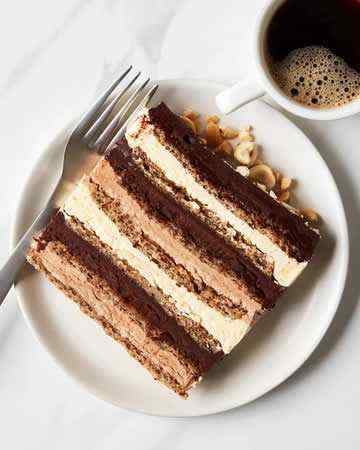 The marjolaine cake may not get quite as much attention as the Opera or Mille-Feuille, but ask any chef who is well-versed in classical French cuisine and it's likely they'll start going on and on about how delicious this layered dessert is. The marjolaine - made with nutty meringue, rich chocolate ganache, and vanilla and hazelnut buttercreams - was created by celebrated French chef Fernand Point. During its heyday in the 1930s, Point's restaurant La Pyramide, located in Vienne, France, was a culinary temple for many - including famed chefs Paul Bocuse and the Troisgros brothers.
At Keller's restaurants, the marjolaine has one layer each of vanilla buttercream, praline buttercream, and dark chocolate ganache, sandwiched between delicate layers of a meringue sponge that incorporates both almond flour and hazelnut flour. Like Point, Keller and his pastry chefs have continued to refine the cake over the years, always looking for ways to improve it, experimenting with different intensities of the chocolate, and dialing in the ideal serving size. At one point, there was even a candy bar-sized marjolaine made for guests at a private event - a delightful, compact version of the cake that was sure to be one of the few Michelin-starred candy bars in the world.
These days, the marjolaine is also popular at Le Coucou in Manhattan. Mark Henning, the restaurant's pastry chef, first came across the cake when he was developing Le Coucou's menu. Like Keller and Point before him, Henning arrived at his current version through much trial and error. "I lost count of how many versions I made but I think it was around 40," Henning tells me over email. His version is rich with chopped hazelnuts, and draped with an elegant, shiny chocolate glaze.
Another pastry chef, who currently works at a three-Michelin-starred establishment and preferred not to be named, shared his love for marjolaine with me. "It's just freaking delicious," he gushed. "The fillings are rich, yet the dacquoise is light and textural." The cake, he says, requires time, patience, and attention to detail, but it's absolutely worth making. Asked if he had any advice for home cooks looking to try it, he emphasized the importance of whipping your egg whites to stiff peaks and not overmixing your batter. And, of course, practice makes perfect.
The recipe may seem daunting, but if you break it into parts, it really is just like any other cake that you might make for a birthday, Valentine's, or any other special occasion: You bake your layers, make your fillings, then assemble. I set aside an afternoon and followed the recipe from The Art of Living According to Joe Beef. Unlike Point and Keller's versions, which call for both almond and hazelnut flour, Morin's streamlined take on the cake uses just hazelnut flour. Instead of praline paste for the buttercream, Morin uses Nutella, which is more widely available for purchase. Morin's cakes also receive an additional brushing of rum, which adds a warming note.
This recipe has three main parts: the cake, the buttercreams, and the ganache. This recipe calls for a steel mold with dimensions of 9x4x3". If you can't find one you can build the cake in a Pullman pan lined with parchment or foil or use a couple of half-gallon milk cartons.
Cake Base:
1½ cups hazelnut powder, packed (200 g)
4 eggs
1⅔ cups + 5 Tbsp. confectioners' sugar, divided (180 g + 40 g)
½ cup all-purpose flour, unbleached, sifted
5 egg whites
¼ tsp. sea salt
Ganache:
12 oz 65% dark chocolate, finely chopped (350 g)
1¼ cups + 3 Tbsp. 35% whipping cream (350 mL)
Vanilla and Hazelnut Buttercreams:
4 egg yolks
1¼ cups granulated sugar (240 g)
3½ Tbsp. water
1½ cups unsalted butter, cut into cubes and at room temperature (340 g)
1 vanilla bean
2 heaping Tbsp. Nutella
6 Tbsp. dark rum (90 mL)
¼ cup hazelnuts, toasted and skinned (35 g)
Preheat the oven to 350°F (180°C/160°C fan, Gas Mark 4). Line two 11x17" (28x43 cm) rimmed baking sheets with parchment paper.
For the Cake:
To make the cake base, spread the hazelnut powder on another rimmed baking sheet, place in the oven, and bake for about 5 minutes, or until it smells like roasting nuts. Remove from the oven and pour into a bowl to cool.
In a stand mixer fitted with the whip attachment (or by hand with determination), whip together the eggs and 1⅔ cups (180 g) of the powdered sugar until white and creamy. Using a rubber spatula, fold in the hazelnut powder and flour just until thoroughly combined. Transfer the mixture to a large bowl, and rinse the whip attachment and the mixer bowl. Dry thoroughly.
Refit the whip attachment to the mixer, and put the egg whites, the remaining 5 Tbsp. (40 g) powdered sugar, and the salt in the bowl. Beat until stiff peaks form. Gently fold the beaten whites into the egg-hazelnut mixture just until no streaks are visible.
Divide the batter evenly between the prepared baking sheets, and spread to level with a spatula, preferably an offset spatula. Place in the oven and bake for 11 minutes, or until lightly browned and set. Let cool in the pans on wire racks for about 10 minutes, then remove the parchment paper by lifting and peeling it slowly off the cakes. Let cool completely.
For the Ganache:
To make the ganache, put the chocolate in a bowl. In a small saucepan, bring the cream to a boil and pour it over the chocolate. Let sit for 3 minutes, then whisk until smooth. Let the ganache sit for 20 minutes at room temperature to firm up a bit.
For the Buttercreams:
To make the buttercreams, rinse the whip attachment and bowl again, then put the egg yolks in the bowl. In a saucepan, combine the sugar and water over medium heat and heat until the sugar melts. Clip a candy thermometer to the side of the pan. When the sugar mixture reaches 226°F (108°C), start whisking the egg yolks. When it reaches 239°F (115°C), remove from the heat while slowly pouring in the yolks and whisking constantly. Continue whisking until the mixture is at room temperature.
Add the butter a few pieces at a time to the cooled egg mixture and whisk until well incorporated. Scoop out half of the mixture into another bowl. Split the vanilla bean lengthwise and, using the tip of a sharp knife, scrape the seeds from the pod halves into one of the bowls and mix well. Add the Nutella to the second bowl and mix well. If you notice a shiny film forming as you are stirring the buttercreams, quickly add a few drops of cold water and continue stirring. The buttercreams are easiest to work with if used right away.
To Assemble:
If you're unable to get your hands on (that is, build) a metal mold in the dimensions described in the headnote, you can use 2 half-gallon (2 L) milk cartons with the top and one long side cut out of each one. Adjust to any desired length by sliding the sides of the two cartons onto one another. Tape the bottom of the mold so that it maintains a perfect rectangle, and line the inside of the mold with parchment paper. With your "mold" built, you are ready to build your cake.
Measure the width of the mold, then cut the cakes into slabs of the same width, minus ¼" (6 mm). Cut the slabs into even lengths to fit the mold. Place a cake layer, shiny brown side up, in the mold and brush a little of the rum over it. Top the cake layer with a layer of the Nutella buttercream, making it slightly thicker than the cake layer. Top the buttercream with a second cake layer, shiny brown side up, and brush with more rum. Top the cake layer with a layer of ganache, making it slightly thicker than the cake layer. Place a third cake layer, shiny brown side up, on the ganache layer and brush with more rum. Add a layer of the vanilla buttercream, making it slightly thicker than the cake layer. Repeat the layers, finishing with a cake layer topped with a layer of ganache. Then add the nuts.
Let the cake rest in the refrigerator overnight. The next day, cut the tape holding the mold together to release the cake. You may discover that the whole thing has sunk a bit, or that the cake has soaked the ganache excessively. No matter. You will have a delicious, silky brick of joy. To serve, cut into slices with a hot, wet knife.
Makes 10 servings.