Opera Cake (French Gâteau d'Opéra)
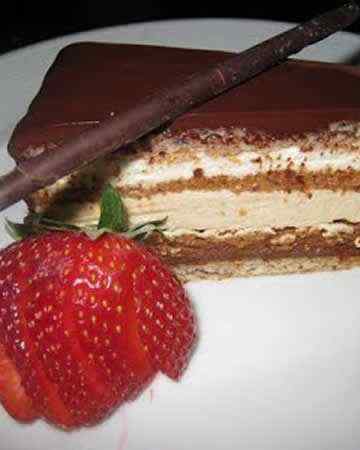 There is much debate as to who, exactly, invented the original opera cake recipe and where. Some culinary historians have set it as far back as the 1890s, while others put its creation at a Paris shop in the mid-20th century. Most opera cake enthusiasts agree that the best - to some, the only - place to buy opera cake is at Dalloyau, where it was named L'Opera in honour of the Paris Opera. Whichever camp you fall into, the delicious taste of coffee and chocolate makes this opera cake recipe well worth the time investment. It includes a total of six layers made of light almond sponge cake (joconde in French), coffee buttercream, and dark chocolate ganache, and it's all topped with a chocolate glaze. If you'd like to give it an authentic finishing touch, pipe the word "opera" on top of each piece using any glaze you have leftover. Do not be put off by the number of ingredients or steps. Read through the recipe at least twice so that you have a good understanding of the ingredients and processes that you'll need to use, then simply take your time. It may seem daunting, but you will be rewarded with the effort you put into this show-stopping French classic dessert.
Almond Cake:
6 large egg whites, room temperature
2 Tbsp. granulated sugar
2 cups almonds, blanched, ground
2¼ cups confectioners' sugar, sifted
6 large eggs
½ cup all-purpose flour, unbleached (60 g)
3 Tbsp. unsalted butter, melted and cooled
Coffee Buttercream:
2 Tbsp. instant espresso
2 Tbsp. water, boiled
1 cup granulated sugar
3 Tbsp. water
1 tsp. pure vanilla extract
1 large egg
1 large egg yolk
14 Tbsp. (7 oz) unsalted butter
Dark Chocolate Ganache:
½ cups whole milk
¼ cup heavy cream
8 oz bittersweet chocolate, finely chopped
4 Tbsp. unsalted butter, room temperature
Chocolate Glaze:
5 oz bittersweet chocolate, finely chopped
½ cup unsalted butter
Preheat the oven to 425°F (220°C/200°C fan, Gas Mark 7). Line two 15x12" pans with parchment paper and brush the surface of the paper with butter. Set them aside for a moment.
Make the Almond Sponge Cake:
Using an electric beater, beat the egg whites on high until they become foamy and start to expand. Sprinkle in the sugar, one tsp. at a time, until all of it is incorporated into the egg whites. Continue beating the meringue until it is glossy and holds stiff peaks.
In a separate bowl, beat the ground almonds, confectioners' sugar, and whole eggs on medium just until the mixture becomes light and foamy.
Gently stir the all-purpose flour into the almond batter.
Then, gently stir ¼ of the almond batter into the whipped egg whites. Fold the remainder of the almond batter and the melted, cooled butter into the egg whites.
Divide the sponge cake batter between the two prepared pans and bake the cakes for 5 minutes, until the surfaces spring back from a light touch.
Cover the top surface of each cake with a fresh piece of parchment and carefully invert them onto a clean surface. Slowly peel back the old parchment from the cakes and allow the paper to rest loosely over the cakes to prevent them from drying out.
Make the Coffee Buttercream:
Stir together the espresso powder and boiling water and set the mixture aside for a moment.
In a medium saucepan, set over medium heat, bring 1 cup sugar, 3 Tbsp. water, and 1 tsp. vanilla extract to a boil. Continue cooking it until it reaches 255°F on a candy thermometer. Remove the sugar syrup from the heat and allow it to cool slightly.
In a separate bowl, beat the egg and egg yolk until they begin to get fluffy.
Continue to beat the mixture and add the hot sugar syrup to the bowl in a smooth, steady, slow stream.
Once the syrup is incorporated, mix in the reserved coffee mixture.
Continuing to beat on medium-high and add the butter, one Tbsp. at a time, until it is fully incorporated into the buttercream. The coffee buttercream is complete once it turns thick and fluffy.
Make the Ganache:
In a medium saucepan, set over medium heat, bring the milk and cream to a boil.
Remove the pan from the heat and stir in the chocolate. Continue stirring the chocolate for 2 minutes, to ensure a completely smooth texture.
Stir in the butter and continue stirring the ganache for 90 seconds.
Assemble the Cake:
Line a large baking sheet with parchment paper. Cut one 10x10" square out of both layers of cake and place one on the baking sheet and the other off to the side. You should have two 12x5" rectangles left over. Cut them down to be 10x5" rectangles.
Carefully spread ¾ of the coffee buttercream over the surface of one cake. Lay the two 10x5" rectangles together to make one 10x10" square. Spread the ganache over another cake in a smooth layer. Place the last 10x10" square of cake over the ganache, and then spread it with a thin layer of the coffee buttercream.
Chill the cake in the refrigerator for 1 hour before glazing it.
Glaze the Cake:
Clarify the butter by boiling it and skimming off and discarding the solids.
Melt the chocolate in a double boiler and stir in the clarified butter until the glaze is smooth; pour the chocolate glaze over the cake.
Allow it to set in the refrigerator, then cut off the edges before serving.
Makes 16 servings.
Cook's Notes:
- Making an opera cake can be spread out over two days. Prepare the cakes and buttercream the first day, then the ganache and glaze when you're ready to assemble.
- The finished opera cake will keep for 1 day in the refrigerator. Make sure to keep it away from food with strong odours.
- The assembled cake can be frozen for up to 1 month when wrapped tightly. If the cake is too large to consume at one time, cut it into smaller squares and freeze those individually. To thaw, keep it wrapped and place it in the fridge overnight.
- Tiramisù is an Italian dessert that is similar in flavour to opera cake. While it's also layered, there are distinct differences. Both desserts combine chocolate and espresso, though opera cake has more chocolate, and the ladyfingers that act as tiramisù's cake layer are soaked in brewed espresso. Additionally, tiramisù is not baked, and the cream layer uses mascarpone cheese.