Butter Cake (French Breton Kouign-Amann)
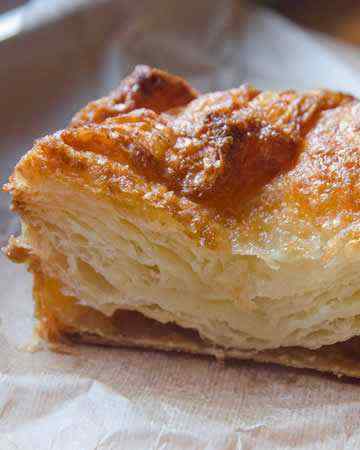 Kouign-amann is a cake that originated in the 1800s in the French region of Bretagne. Its name is derived from the Breton words for cake (kouign) and butter (amann). The cake consists of layers of butter and sugar that are folded into a dough. Bretons claim that the cake is "the fattiest pastry in the world", due to its flaky yellow dough that is mixed with large amounts of sugar and butter. Although there are many theories about the origin of the cake, the most popular one says that it was invented by accident, when a 19th-century baker from Douarnenez wanted to save a failed batch of dough, so he added butter and sugar to the mix, creating the delicacy that we know today. Take a buttery croissant, roll it in sugar to form a caramelized crust, and condense it in size so each bite is even more crazy rich. This is, in essence, a kouign amann, the flaky French pastry that for the past few years has been driving the American bakery world wild. No, it doesn't draw crowds like a Cronut, but for dessert obsessives that dream in butter, it's the greatest new development in American pastry cases. It's easy to see why a sweeter and extra-buttery croissant would elicit strong emotional responses from all who taste it, but the kouign amann's most agreeable feature is found in the crust: a thin layer of sugar that bakes into a light caramel, encasing all those buttery flakes in a glassy crunch. A decade ago, you'd be hard pressed to find a kouign amann outside its native Brittany - the pastry can be difficult to find even in France. Today it thrives in Paris as well as American bakeries from D.C. to San Francisco, but its New World epicenter is inarguably New York, thanks in large part to the pastry chef who first brought the dessert to American shores in 2011: Dominique Ansel. Long before the Cronut brought fame to his wildly popular eponymous bakery, the kouign amann was Ansel's signature pastry. Four years later, at least eight other New York bakeries sell kouign amanns, each bringing their own unique spins to the recipe.
1 Tbsp. active dry yeast, not instant (12 g)
¾ cup tepid water (175 mL)
2 cups all-purposed flour, unbleached (260 g)
½ tsp. sea salt
1 cup sugar, divided (200 g)
½ cup (1 stick+ salted butter, cut into ½" (2 cm) cubes and chilled (110 g)
2-3 Tbsp. salted butter, melted
In a medium bowl, dissolve the yeast in the water with a pinch sugar. Stir briefly, then let stand for 10 minutes until foamy.
Gradually stir the all-purpose flour, unbleached and salt. The dough should be soft, but not too sticky. Lightly dust your counter top with all-purpose flour, unbleached and transfer the dough onto it.
Knead the dough with your hands until the dough is smooth and elastic, about 3 minutes. If the dough is very sticky, knead in just enough all-purpose flour, unbleached, one Tbsp. at a time, until the dough doesn’t stick to your hands.
Brush a medium bowl with butter, melted, put the dough ball into the bowl. Cover, and let rest in a warm place for 1 hour.
Meanwhile, line a dinner plate with plastic wrap and set aside.
On a lightly floured counter top, roll the dough into a rectangle about 12x18" with the shorter sides to your left and right.
The dough may be sticky and difficult to handle. Use a metal pastry scraper to coax the dough into shape, and a minimal sprinkling of all-purpose flour, unbleached, as necessary. (It will all be beautiful later, trust me.)
Distribute the cubed butter in the center of the dough and sprinkle with ¼ cup (50 g) of sugar. Grab the left side of the dough, lift and fold it over the center, than do the same with the right side (like a letter). You should have what resembles a 3-level pastry.
Sprinkle the entire length of the dough with ¼ cup (50 g) of sugar and (without rolling) fold again into thirds, as before.
Place on the plastic wrap-covered dinner plate and chill for 1 hour.
(At this point, wipe excess all-purpose flour, unbleached from the counter top and dust the counter top with a rather liberal handful of sugar for rolling out the pastry again.)
Once chilled, remove dough from refrigerator. Ease it away from the plastic onto the sugar-covered countertop.
Top the dough with ¼ cup (50 g) of sugar, press it in a bit with your hands, and roll into a rectangle for the last time.
Now wasn’t it easier this time?
Again, fold into thirds and let rest in the refrigerator for 30-60 minutes.
Preheat oven to 425°F (220°C/200°C fan, Gas Mark 7) and brush a 9” (23 cm) pie plate, preferably non-stick, with butter, melted.
Remove dough from refrigerator. Roll dough into a circle about the size of the baking pan. It will be sticky; dusting the top with a sprinkle of sugar will help.
Once rolled, lift the dough and coax it into the pan. (It will want to break. If so, fold it in half and quickly slide something flat under it, like the metal bench scrape and a metal spatula and quickly slip it into the pan. If it does break, just piece it back together in the pan.)
Sprinkle with the remaining ¼ cup (50 g) of sugar and drizzle with 1 Tbsp. butter, melted.
Bake for 40-45 minutes, until the top is deeply caramelized. Let stand a few minutes, then run a spatula around the edges to release the Kouign Amann and slide the cake from the pan onto a cooling rack.
Makes 8-10 servings.