Danube Waves Cake (German Donauwellen Kuchen)
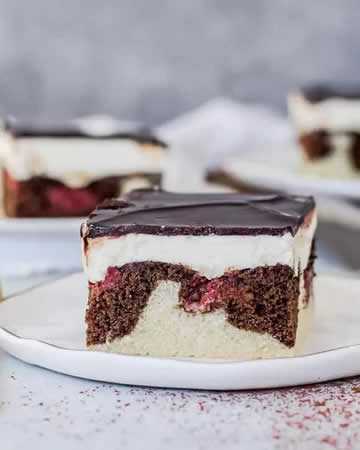 Donauwellen Kuchen or Donauwelle is a traditional sheet cake popular in Germany and Austria. It is traditionally made of layers of vanilla and chocolate pound cake combined to have a wavy border between them. It contains sour cherries and is topped with buttercream and chocolate glaze. The cake's name comes from its wavy pattern inside and its swirled chocolate decoration, although the reason for naming it after the Danube in particular is not clear. It could refer to its popularity in those countries that the river flows through. Other names for the cake are Schneewittchenkuchen, meaning 'Snow White Cake' and Schneewittchentorte, referring to its colour scheme of black, white and red, like the character of Snow White in the Brothers Grimm's fairy tale.
German Buttercream:
½ cup granulated sugar, divided
¼ cup cornstarch
2 large eggs
1 cup + 3 Tbsp. whole milk
2 Tbsp. unsalted butter, at room temperature
1¼ cups unsalted butter, at room temperature
1 cup confectioners' sugar
1½ tsp. pure vanilla extract
1/8 tsp. sea salt
Cake Layer:
2 cups all-purpose flour, unbleached
1 tsp. baking powder
½ tsp. baking soda
½ tsp. sea salt
1¾ cups granulated sugar
2 tsp. pure vanilla extract
4 large egg whites, at room temperature
8 Tbsp. unsalted butter, at room temperature
1⅓ cups buttermilk
¼ cup cocoa powder
1 Tbsp. whole milk
1 (15 oz) can tart cherries in water, drained well
Chocolate Topping:
5 oz dark chocolate, finely chopped
½ cup heavy cream
1 Tbsp. light corn syrup
For the German Buttercream:
Stir ¼ cup of the sugar together with the cornstarch in a small mixing bowl and set aside.
Crack the eggs into a medium heat-proof bowl. Whisk the eggs together and set the bowl next to the stove.
Combine the milk and remaining ¼ cup of sugar in a small saucepan set over medium heat and bring to a simmer, stirring occasionally. Once the milk has come to a simmer, whisk the sugar-cornstarch mixture into the eggs until smooth.
Whisking the eggs constantly, add a scant ¼ cup of the hot milk to the eggs. Still whisking constantly, pour the remaining milk into the eggs in a slow stream.
Return the mixture to the saucepan and set pan over medium-low heat. Cook, stirring constantly with a rubber spatula, until the mixture thickens a bit - it will start to get lumpy.
Turn the heat to low and switch to stirring with a whisk. Whisk vigorously until the mixture is very thick and smooth - if you don’t get your pudding completely smooth, you’ll have lumps in your frosting.
Remove from the heat and stir in the 2 Tbsp. of butter.
Scrape the pudding into a shallow mixing bowl and press plastic wrap directly on the top of the pudding. Chill in the fridge for 90 minutes to 2 hours (or until thoroughly chilled). You'll finish the frosting later. While the pudding is chilling, make the cake.
For the Cake Layer:
Preheat the oven to 350°F (180°C/160°C fan, Gas Mark 4). Spray a 9x13" baking pan with cooking spray and set aside.
Whisk the flour, baking powder, baking soda and salt together in a small mixing bowl and set aside.
Beat the butter in a large mixing bowl with an electric mixer set to medium until very smooth. Beat in the sugar and vanilla until well combined (mixture will be crumbly). Add the egg whites one at a time, beating well after each addition.
With mixer on low, beat in half of the flour mixture followed by half of the buttermilk and beat to combine. Add the remaining flour mixture, then the remaining buttermilk and beat until just incorporated.
Spread three-quarters of the batter into the prepared pan. Sift the cocoa powder over the remaining batter and add the milk; stir until fully combined.
Dollop the chocolate batter over the vanilla batter and carefully spread into an even layer with an offset spatula (don’t swirl them together, just spread the chocolate batter over the vanilla). Sprinkle the drained cherries over the cake batter.
Bake 35-40 minutes, until a cake tester inserted into the center of the cake comes out clean.
Remove cake from the oven and cool completely on a wire rack before adding the frosting.
Once the pudding and the cake are both cooled, finish the buttercream. Remove the chilled pudding from the fridge and allow it to come to room temperature.
Transfer the room temp pudding to the bowl of a stand mixer fitted with the whisk attachment and beat on medium for several minutes, until it’s very light and creamy.
With mixer still on medium speed, add the butter half a Tbsp. at a time, stopping mixer to scrape with a rubber spatula every so often.
Once the butter is fully incorporated, add the powdered sugar, vanilla, and salt, and beat until smooth. Spread over the fully cooled cake. Refrigerate for 1 hour to set the buttercream before adding the chocolate topping.
For the Chocolate Topping:
Place the chocolate in a small heat-proof bowl. Heat the cream in a medium saucepan set over medium heat until it just begins to steam. Pour over the chocolate and allow to sit for 3 minutes.
Add the corn syrup, then whisk the chocolate and heavy cream together until the chocolate is melted and mixture is smooth. Allow to cool for 10 minutes.
Remove cake from the fridge and spread the chocolate into an even layer over the buttercream. Refrigerate to set the ganache, then serve.
Makes 16 servings.
Cook's Notes:
- Because this is a complicated cake I strongly suggest that you read through the entire recipe before beginning. There are step-by-step photos in the post to help you with visuals.
- Be sure when you make your buttercream that both the pudding and the butter are at room temperature. If the pudding is too hot it will melt the butter; if either is too cold they won't whip together nicely.
- If you don’t want to buy a whole carton of buttermilk for this cake, you can substitute 1⅓ cups whole milk mixed with 1 Tbsp. of lemon juice or white vinegar. Let the mixture sit for 5 minutes before using.
- Store the cake loosely covered with plastic wrap in the fridge for up to 3 days or in the freezer for up to 3 months.