Chocolate Cake (Austrian Sachertorte)
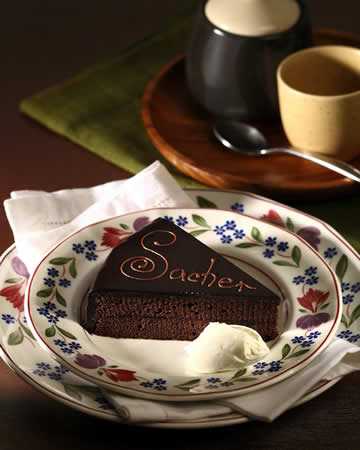 The original Sachertorte is the most famous Austrian cake. It is a classic, layered chocolate sponge cake that is thinly coated with high-quality apricot jam and topped with chocolate icing. Sachertorte is said to taste the best when accompanied by a small cloud of unsweetened whipped cream on the side. It was invented in 1832 by Franz Sacher, a pastry chef for Prince Clemens Lothar Wensel Metternich, the State Chancellor of Austria at the time. The prince wanted a new cake and Sacher, 16 years old at the time, obliged him by creating something new from ingredients that were readily available in the kitchen. Suffice to say, the cake was a huge hit, and Franz's son Eduard opened a hotel called Sacher in 1876, serving the popular cake up to this day. Today, almost every coffee house in Vienna has its own version of the cake, but no two cakes are quite alike. In order to avoid confusion, it is recommended to look for the official Sacher chocolate seal on top of the cake, which can only be found on the Original Sacher, produced by Hotel Sacher in a quantity of approximately 360,000 cakes per year. Interestingly, from 1954-1963, Hotel Sacher went through a legal battle with their rival, Demel cafe, and the court proceedings focused on which one had the right to call its Sachertorte the original. The issues that were discussed included whether the cake should have an additional layer of apricot jam in the middle, and whether to use margarine or butter. Following a long seven-year dispute, the parties have reached an agreement - and the Sachertorte is only made in Vienna and Salzburg, and it is shipped from both locations, still, today.. Nevertheless, the Demel version, which does not have the additional layer of apricot jam in the middle, is almost equally popular.With the original recipe being kept a secret and exclusive to Hotel Sacher, according to the Austrian Tourist Board, this is the go-to for Sachertorte.
Sachertorte:
7 Tbsp. unsalted butter, softened
½ cup confectioners' sugar, sifted
3.5 oz bittersweet chocolate, melted and cooled
1 pinch sea salt
7 Tbsp. superfine sugar
¾ cup + 1 Tbsp. cake flour
6 large eggs, separated
Apricot and Rum Filling:
¼ cup water
¼ cup white sugar
3 Tbsp. dark rum, divided
1 (12 oz) jar apricot preserves
1 Tbsp. water
Chocolate Glaze:
1 cup granulated sugar
1 cup bittersweet chocolate, finely chopped
To Serve:
whipped cream
Preheat to 350°F (180°C/160°C fan, Gas Mark 4). Position a rack in the center of the oven. Butter a 9x2.5" spring-form pan and line the bottom with a parchment or greased waxed paper circle.
With an electric mixer on low speed (or with a stationary mixer fitted with the paddle attachment), beat the butter for 1 minute, or until light. Add the confectioners' sugar and beat for 2 minutes longer.
Add the egg yolks two at a time, beating for 10 seconds between additions, or until absorbed by the butter. Scrape down the beaters and sides of the bowl and beat for 1 minute longer, or until smooth. Add the melted chocolate and mix until combined.
Whip the egg whites with a pinch of salt until they form soft peaks. With the machine running, add the superfine sugar, about 2 Tbsp. at a time, and beat until the egg whites are stiff and glossy. With a rubber spatula, fold ½ the egg whites into the batter. Transfer the flour to a strainer and sift it over the batter as you fold it in along with the remaining beaten egg whites.
Transfer the batter to the prepared cake pan, smooth the top, and set the pan on a larger baking sheet (to catch the drips). Bake for 40-45 minutes, or until a tester inserted in the center comes out dry.
Cool the cake to room temperature in the pan on a wire rack. Run a knife around the cake to loosen it from the sides, then unlock the spring-form and lift the cake out of the ring.
Bring ¼ cup water and sugar to a boil in a small saucepan. When the sugar has dissolved and the syrup is clear, remove from heat and stir in 2 Tbsp. rum. Brush 1/3 of the syrup onto the cut side of the cake bottom.
Puree the apricot preserves with 1 Tbsp. of water until smooth. Bring to a simmer over medium heat in a small saucepan, and cook until thickened, about 2 minutes. Stir in remaining rum, and then spread 1/3 of the jam mixture onto the cut side of the cake bottom. Place the top of the cake onto the bottom. Brush the outside of the cake with the remaining syrup, then spread remaining apricot preserves over the top and sides; refrigerate until the icing is ready.
Bring the sugar and ½ cup water to a boil in a small saucepan and cook until a candy thermometer registers 220°F. Add the chocolate, stir, and cook until a candy thermometer registers 230°F. Remove the saucepan from the heat and stir constantly until smooth.
Pour the hot glaze slowly back and forth over the top and sides of the cake. Be generous as you pour so that the sides get covered, because the glaze can't be moved once it is on the cake. If there are any unglazed patches on the sides of the cake, use a small offset spatula to patch the nude spots with more glaze.
Let the cake stand for 1 hour before transferring it to a plate or platter.
Serve with a dollup of whipped cream.
Cook's Notes:
- Cake: For a flat sponge, when baked, transfer the cake immediately on a flat surface and turn it once again after 25 minutes. Also, it's important to gently fold in the flour and the egg whites so that the cake doesn't lose on volume.
- Jam: Apricot jam being one of the staples of the original recipe, can be substituted with other types if needed. Sometimes the jam is too hard and needs to be heated for easier spreading over the cake or diluted with water. A shot of brandy or rum mixed into the jam is also a nice touch.
- Storage: The cake is best when eaten the day it's made, although you can store the cake in an airtight container for up to two days at room temperature. Be careful not to leave the cake in the refrigerator as it will "sweat".