Brisket (Jewish)
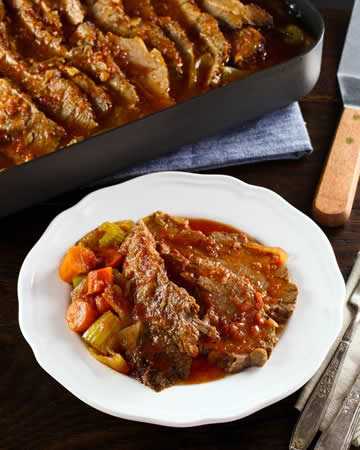 Jews living in Eastern Europe rarely had the money to buy better cuts of meat. They learned to make do with cheaper kosher cuts, like brisket, often overlooked for its toughness. Cooking the brisket low and slow breaks it down, resulting in a tender piece of meat. This Jewish tradition continues today, and brisket is often served for special holidays and occasions. On Shabbat, it is added to a pot with vegetables and potatoes to make a slow-cooked meaty stew known as cholent. At Rosh Hashanah, it is added to root vegetables with sweet dried fruits and slow cooked into tzimmes. When Ashkenazi Jewish immigrants came to the United States, they brought their love of brisket with them. Jewish deli owners pickled the brisket to make corned beef or pastrami. But for the holidays, nothing could replace the comforting, hearty flavour of an oven-roasted brisket. The secret to a cooking brisket is twofold - brisket needs fat and time to come out tender and delicious. Choose a cut with nice marbling; the more fat you can see, the more tender the meat will be. If buying grass fed (which tends to be leaner), make sure there is a fat layer and don’t let the butcher trim it. And of course, allow yourself plenty of time to cook your brisket. If you can, make it a day or two ahead- the flavour will improve with time. This brisket slow cooks for hours, so the final product flakes tenderly and simply melts in your mouth. The sauce is rich and flavourful, and the slow cooked vegetables are soft, like butter. The flavour is perfect for any special celebration, but particularly suited to the Jewish holidays.
1 (5-7 lbs) brisket, first or second cut (do not trim fat - especially if it's grass fed)
¼ cup extra-virgin olive oil, divided
2 large brown onions, peeled and sliced
1 lb carrots, peeled and sliced
1 lb celery, peeled and sliced
1 (28 oz) can tomatoes, whole, diced, or crushed
10 cloves garlic, peeled
½ cup brown sugar
¼ cup apple cider vinegar
2 cups beef or chicken broth, divided
sea salt
black pepper, freshly ground
You will also need: Large roasting pan, blender or food processor, large skillet, spatula, parchment paper, aluminum foil, large glass or ceramic baking dish (if making ahead), plastic wrap (if making ahead), sharp carving knife
Preheat the oven to 300°F (150°C/130°C fan, Gas Mark 2).
Rinse the brisket and pat dry. Rub both sides of the meat with black pepper and salt.
Heat a large skillet over a medium flame on the stove top. Drizzle 2 Tbsp. of olive oil into the pan. Brown the brisket on both sides - it will take 4-5 minutes per side. A large brisket may overlap the edges of the skillet; you can brown it in stages, letting half the brisket overlap the edge, then adjusting it to brown the other half.
While brisket is browning, pour canned tomatoes, garlic, brown sugar, apple cider vinegar, and 1½ cups broth into a blender or food processor. Add 2 tsp. of salt (or 1 tsp. if using a salted kosher cut of brisket) and ¼ tsp. of black pepper. Pulse till garlic is chopped small and all ingredients are combined.
Remove the browned brisket from the skillet.
Drizzle 2 Tbsp. more olive oil in the pan and add the sliced onions. Sauté them over medium high for a few minutes until they begin to soften and shrink in size.
Add the carrot and celery slices. Sauté for another 5-6 minutes until the onions are soft and browning and the vegetables are fragrant.
Pour the vegetables out of the skillet and onto a plate, reserve. Pour ½ cup beef or chicken broth into the skillet and let it heat up. Use a spatula to gently scrape up any brown bits that are clinging to the skillet. Turn off heat.
Pour half of the tomato mixture into a large roasting pan. Place brisket on top of the tomato sauce, fat cap facing up. Pour the sautéed vegetables across the top of the brisket, along with the broth and brown bits. Pour the remaining tomato sauce over the top of the vegetables and brisket.
Cover the roasting pan tightly with a layer of parchment paper followed by a layer of foil. The parchment forms a protective layer between the meat and sauce (which is acidic) and the foil.
Place brisket into the preheated oven. Let it roast undisturbed for 5-7 hours. It will take about 1 hour per lb of meat (leaner cuts of meat like grass fed may take longer-test for doneness). Brisket is ready when it flakes tenderly when pierced with a fork. You can let it cook even longer for a soft, shredded texture if that’s what you prefer. When fully cooked, the brisket will have shrunk in size.
I recommend making this brisket ahead; allowing it to sit in the refrigerator for 1-2 nights will improve the flavour. If you would like to do this, skip ahead to where it says “Make Ahead Directions.” If you are not making ahead, continue reading.
Remove brisket from the pan and let it rest on the cutting board fat-side up for 20-30 minutes. Meanwhile, pour the sauce and vegetables from the roasting pan into a smaller saucepan. Skim fat from the surface of the cooking sauce, then reheat the sauce till hot (not boiling).
Cut fat cap off the brisket, then cut the brisket in thin slices against the grain. Serve topped with hot tomato sauce and softened veggies.
Make-Ahead: Open the foil to vent and let the brisket slowly return to room temperature. Switch the brisket and sauce to a ceramic or glass dish (metal from the roasting pan can react with the acid in the sauce, which can cause an off taste if left to sit). Cover with plastic wrap and place in the refrigerator. Let the brisket chill overnight, or up to two days. You can also freeze the brisket if you prefer.
1-2 hours before serving, remove the brisket from the refrigerator and preheat your oven to 350°F. The fat in the sauce will have risen to the top, turned white, and solidified. Use a spoon to scoop the fat bits out of the sauce and discard.
Take the brisket out of the dish and brush any excess sauce back into the dish. Place brisket on a cutting board, fat-side up. Slice the meat cold-first cut the fat cap off the brisket, then cut the brisket in thin slices against the grain.
Return the sliced meat to the dish and spoon sauce over it, making sure to spoon a little sauce between each slice. Cover the dish with a layer of parchment paper, then with foil, and place it in the oven.
Let the brisket roast for 45-60 minutes until heated through. You can cook it even longer to let it become more tender, if you wish. Serve with hot sauce and softened veggies.
Makes 12 servings.