Cheese Turnover (Jewish) Sambusak
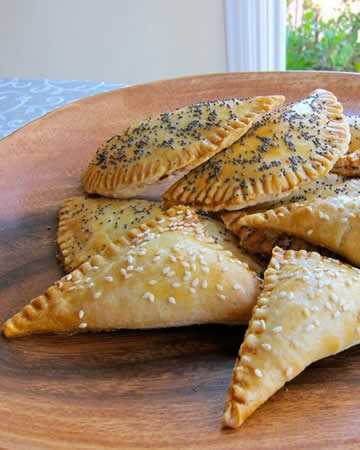 Sambusak (sometimes called sanbusak) are a popular treat throughout the Middle East; they’ve been around since Persian Babylonian times and have been enjoyed by the Sephardic Jews for centuries. These savoury turnover pastries, similar to hand pies, are stuffed with a variety of fillings, from ground lamb or beef to chickpeas to chicken to spinach. Sambusak are the ancient ancestors of similar pastries such as Indian samosas, Latin American empanadas, Italian calzones and Israeli borekas. Iraqi Jews and other Sephardic Jewish groups make them year-round as a portable and tasty light meal. At Purim, Jewish cooks usually stick to meatless fillings like seasoned chickpeas, lentils, or cheese. Sambusak are traditionally fried, but I prefer to bake them - it’s healthier and easier. You can deep-fry them in oil if you prefer, but there is really no need since the dough bakes up quite nice and is full of flavour. I like using a mixture of kashkaval and feta cheese for the filling You can use one cheese or the other if you prefer, just make sure you use 12 oz of cheese total. Don’t forget the fresh parsley, it really compliments the filling and completes the dish. Serve these Cheese Sambusak alongside a meatless dairy Purim meal (or for Shavuot, another meatless holiday). The holiday of Purim is often celebrated with a meatless menu in honor of Queen Esther, who became a vegetarian to keep kosher in the palace of her non-Jewish husband King Ahasuerus. Stuffed foods are traditional for Purim, as are triangle-shaped foods, and these cheese sambusak fit the bill in both regards! They will last several days in a sealed plastic bag or container, and they don’t require refrigeration, making them a great addition to your Mishloach Manot baskets (traditional Purim food gift baskets). Sprinkle them with poppy or sesame seeds for even more Purim symbolism - as a vegetarian, Queen Esther got her protein from seeds, nuts and legumes. The seeds also add a nice crunch to the coating. Sambusak go great with a hardy vegetarian dish like Jacob's Lentil Stew .
½ cup canola oil
½ cup unsalted butter, melted
½ tsp. kosher salt
½ cup hot water
3 cups all-purpose flour, unbleached
6 oz feta cheese, crumbled
6 oz kashkaval cheese, crumbled
¼ cup fresh parsley, chopped
3 eggs, divided
¼ tsp. black pepper, freshly cracked
poppy or sesame seeds for topping (optional)
vegetable oil (if frying - choose oil with a high smoke point)
Make the Pastry Dough: Combine canola oil, melted butter, and salt in a mixing bowl. Mix in the hot (not boiling) water. Gradually stir in the flour, a ½ cupful at a time, till a soft and oily dough forms.
When the dough becomes too thick to stir, use your hands to work the last bit of flour into the dough. Don’t over-knead-stop when the ball holds together and the dough is smooth. Cover with plastic wrap and let it sit for a few minutes while you make your filling.
Don’t let the dough sit for longer than 30 minutes before rolling it out, or it will cool down and become more difficult to work with.
Make the Filling: In a food processor, combine feta and kashkaval cheeses, parsley, 2 eggs and black pepper in a food processor. Pulse ingredients till a light creamy paste forms.
Preheat your oven to 350°F.
While the oven is heating, assemble your sambusak. There are a couple of ways to do this. The Half-Moon shape is more popular because it’s easiest to do; the Triangle Shape is popular for Purim because it’s reminiscent of Haman’s hat.
To Make Half Moon Shape: Flour your rolling surface. Pull a walnut-sized piece of dough from the dough ball; recover the dough ball.
Lightly flour your rolling pin. Roll the dough out into a rough circle that is between 4½ and 5” wide. The dough will be quite thin.
Place 1 Tbsp. of filling in the center of the circle. Fold the circle in half over the filling. Seal the edges by pinching gently with your fingers to create a half-moon shape.
Use a fork to score the edges of the sambusak - this will help seal them and also make them look pretty.
Repeat process until all of the dough has been used. I find it’s easiest to roll out five dough pieces at a time, stuff them and seal them, then roll out five more. This saves time and is more efficient them rolling, stuffing and sealing each individual piece.
To Make Triangle Shape: Flour your rolling surface. Divide your dough into four equal-sized sections.
Choose one section to work with, keep the other sections under plastic wrap till you’re ready to use them. Lightly flour your rolling pin. Roll the dough out till it is very thin. You will want to cut a square with 8-10” sides from the dough, so keep this in mind as you roll it out; I sometimes use a ruler to help gauge the size.
Once your dough is rolled out, cut a square with equal length sides from the dough. The square should be somewhere between 8-10” wide. Use a ruler or straight edge to cut the sides as straight as possible.
Push extra dough trimmings into a small ball and store it under the plastic wrap separate from the rest of the dough. Cut the square into equal-sized quarters. Each of these quarters will be used to form a sambusak.
Cut the square into equal-sized quarters. Each of these quarters will be used to form a sambusak. Place 1 Tbsp. of filling into the center of each square. Fold one corner of a square over to the diagonally opposite corner and pinch to seal the sides. Use a fork to score the edges of the sambusak - this will help seal them and also make them look pretty.
Repeat process for remaining squares. Roll out remaining dough sections in the same way, using the ball of trimmings as a fifth and final section of dough.
Once your sambusak have been assembled, they are ready to be cooked. You can either deep fry them or bake them. I prefer to bake them because of the more consistent results (plus it’s healthier) - but frying is more traditional.
To Bake Sambusak: Place sambusak on a lightly greased or parchment-lined cookie sheet.
Beat the remaining egg with 1 tsp. of cold water. Brush the sambusak with a thin layer of the egg wash. Sprinkle the sambusak with poppy seeds or sesame seeds, if desired. Bake sambusak at 350° F for about 40-45 minutes until golden brown.
To Fry Sambusak: Do not use egg wash or coat with seeds. Heat an oil with a high smoke point (like grapeseed) over medium until hot, but not smoking.
Fry the sambusak in batches of four till golden, turning halfway through cooking.
Drain on a paper towel before serving.
Serve sambusak warm or at room temperature. They’re best straight from the oven, but the baked ones also keep quite well, and can be reheated if desired.
Cook's Notes: Assembled uncooked sambusak can be stored in the refrigerator for up to 24 hours prior to baking. You can also freeze them; just pop them in the oven directly from the freezer, brush with egg wash and sesame or poppy seeds (if using), and bake till golden brown. If frying, let them defrost for about 20 minutes prior to placing them in the hot oil.