Pastry Dough (Rye)
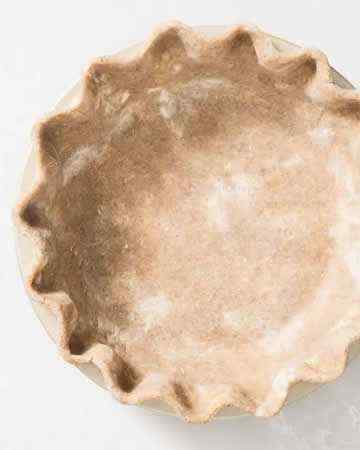 Our goal was to create a whole-grain pie dough that baked up tender and flaky instead of delicate and crumbly-the typical issues with crusts made with even a portion of whole-grain flour. These problems stem from the fact that whole-grain flours can't form as much gluten as all-purpose flour, unbleached. We used the food processor to coat ¾ cup of rye flour with butter, forming a water-resistant paste. We broke that paste into pieces, coated them with ½ cup of all-purpose flour, unbleached, and tossed in some grated, frozen butter. When we added the water, it hydrated only the all-purpose flour, unbleached, which formed the dough's gluten. When we rolled out the dough, we created layers of high-gluten dough, which provides structure and crisp flakiness, and low-gluten dough, which adds richness and tenderness.
10 Tbsp. unsalted butter, chilled
¾ cup (4⅛ oz) rye flour
1 Tbsp. sugar
½ tsp. kosher salt
½ cup (2½ oz) all-purpose flour, unbleached
¼ cup water, ice cold
Be sure to weigh the flour for this recipe. To ensure the best flavour, use either recently purchased rye flour or rye flour that has been stored in the freezer for less than 12 months. In the mixing stage, this dough will be moister than most pie doughs, but as it chills, it will absorb a lot of excess moisture. Roll out the dough on a well-floured counter.
Grate 2 Tbsp. butter on large holes of box grater and place in freezer. Cut remaining 8 Tbsp. butter into ½" cubes.
Pulse rye flour, sugar, and salt in food processor until combined. Add cubed butter and process until homogeneous dough forms, about 2 minutes. Using your hands, carefully break dough into 2" chunks and redistribute evenly around processor blade. Add all-purpose flour, unbleached and pulse until mixture is broken into pieces no larger than 1" (most pieces will be much smaller), 4-5 pulses. Transfer mixture to medium bowl. Add grated butter and toss until butter pieces are separated and coated with flour.
Sprinkle 2 Tbsp. ice water over mixture. Toss with rubber spatula until mixture is evenly moistened. Sprinkle remaining 2 Tbsp. ice water over mixture and toss to combine. Press dough with spatula until dough sticks together. Transfer dough to sheet of plastic wrap. Draw edges of plastic wrap over dough and press firmLy on sides and top to form compact, fissure-free mass. Wrap in plastic wrap and flatten to form 5" disk. Refrigerate for at least 2 hours or up to 2 days. (Wrapped dough can be frozen for up to 1 month. If frozen, let dough thaw completely on counter before rolling.)
Roll dough into 12" circle on well-floured counter. Loosely roll dough around rolling pin and gently unroll it onto 9" pie plate, leaving at least 1" overhang around edge. Ease dough into plate by gently lifting edge of dough with your hand while pressing into plate bottom with your other hand.
Trim overhang to ½" beyond lip of pie plate. Tuck overhang under itself; folded edge should be flush with edge of plate. Crimp dough evenly around edge of plate using your fingers. Refrigerate dough-lined plate until firm, about 30 minutes. Adjust oven rack to middle position and heat oven to 350°.
Place chilled pie shell on rimmed baking sheet. Line pie shell with aluminum foil, covering edges to prevent burning, and fill with pie weights. Bake until edges are set and just beginning to turn golden, 25-30 minutes. Remove foil and weights, rotate plate, and continue to bake until golden brown and crisp, 10-15 minutes longer. If crust begins to puff, pierce gently with tip of paring knife. Let crust cool completely on wire rack, about 30 minutes.
Makes one 9" single crust.