Pâte Feuilletée (French Puff Pastry)
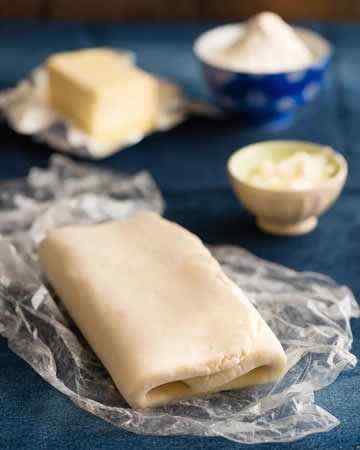 Better known as puff pastry, this is another staple of viennoiserie. Pâte feuilletée is used to make croissants, palmiers, and even savoury dishes such as the Beef Wellington. Pâte feuilletée is a French influence in Moroccan kitchens and bakeries. The dough is kept chilled as it's made and laminated multiple times with butter, creating distinct layers which, when cooked, form pockets of air throughout the pastry. This technique is based on the classic French method of making puff pastry, but is assembled inverted, or “inside out”. Where a traditional puff pastry is made by wrapping a block of butter (beurrage) with a flour/water dough (détrempe) and then folded, this recipe does the reverse and folds the dough with the butter. It is no more challenging a method than the traditional way, but it does result in a remarkably flaky and tender puff pastry that rises evenly and rolls out easily. Puff pastry does take time to make, as it must rest in between folds, but it is well worth the effort. This recipe makes enough for an assortment of baked items. If just preparing one of these, any excess dough can be frozen for later use. Simply thaw in the fridge before rolling and using.
4 cups all-purpose flour, unbleached (500 g)
2 tsp. kosher salt
7 Tbsp. unsalted butter, chilled and cut into pieces (100 g)
1¼ cups water
14 oz butter, room temperature (400 g)
½ cup all-purpose flour, unbleached (60 g)
Make the Dough (Détrempe):
Measure four cups of flour and two tsp. salt into a large bowl, stirring to mix. Add the cold butter pieces, blending them into the flour with your fingers or a pastry cutter until the mixture looks like coarse meal.
Now add the cold water. Stir briskly with a fork or your fingers until rough dough forms and pulls from the side of the bowl. (If necessary, you can add more cold water, one Tbsp. at a time, to achieve this.)
Knead the dough on a floured surface two or three minutes until smooth, adding flour as necessary to keep the dough from sticking. Wrap the dough in plastic and chill for 30 minutes, up to 2 hours.
Mix the Butter and Flour (Beurrage):
While the dough is chilling, mix the softened butter with the flour. Transfer it to a large piece of plastic wrap and cover the butter with a second piece of plastic wrap. With your hands (or a rolling pin or spatula), flatten and shape the butter into a rough 8" or 9" square. Set the butter in the fridge to firm up.
Add the Butter to the Dough (Lamination):
After the dough has chilled for 30 minutes, remove it and the butter from the fridge. The butter should now be firm but pliable.
On a lightly floured surface, roll the dough out into an 11" or 12" square. (There's no need to measure; just be sure that it's a little larger than your square of butter.) Set the chilled butter so that it sits diamond-shaped in the center of the square-shaped dough.
Fold the corners of the dough inward to enclose the butter completely. Press the edges of the dough together to join them.
First Rolling and Folding of the Dough:
The dough with butter now needs to be rolled out and folded six times. Depending on how warm your kitchen is, you'll need to return the dough to the fridge to chill and rest between each folding (or "turn"), or after every two turns. This is to avoid the butter becoming so soft that it runs or weeps out of the dough while you work with it.
Lightly flour your surface. With the side of a rolling pin, firmly hit or tap the dough with the side of your rolling pin to mold the dough (and enclosed butter) into a rectangle. Once the rectangle has taken shape and butter has softened a bit, you can switch to rolling out the dough to shape it into an elongated rectangle about ¼" thick. (Turn the dough several times while you work and dust your work surface with more flour as needed to prevent the dough from sticking.)
Straighten the edges of your rectangle by molding them with your hands, the side of a rolling pin, or with a dough scraper. Then, fold the rectangle into thirds as you would for a letter-short sides inward, evenly overlapping in the center, to form three visible layers. (Brush off any excess flour as you fold and take care to align the edges neatly.) This completes the first folding.
If the butter has not started to run, proceed to the second folding. Otherwise, wrap the dough in plastic and chill in the fridge for 20-30 minutes.
Second Rolling and Folding of the Dough:
Reposition the dough a quarter turn and roll it out into another elongated rectangle about ¼" thick. Again, turn the dough several times and flour your surface as needed. Mold the edges of the rectangle into straight sides and fold the rectangle into thirds, brushing off excess flour and aligning the edges. This completes the second folding.
Wrap the dough in plastic and chill the dough for 20-30 minutes, or up to 2 hours.
Roll Out and Fold Four More Times:
Repeat the rolling out and folding four more times, for a total of six times, chilling the dough as necessary between every turn, or between every two turns. (Note: Do not complete more than two turns at a time without resting and chilling the dough.)
When all six turns have been completed, wrap the dough and chill it for another hour or two before using. It will keep in the fridge for two days, or you can divide it into portions for freezing.
Frozen puff pastry dough, well wrapped, will keep for one year. Thaw it at room temperature for 30 minutes or overnight in the fridge.
Makes about 3 lbs (about 1350 g).
The dough can be divided into portions, wrapped in plastic and frozen for up to one year.
Cook's Notes:
Pâte feuilletée is essential for classic French pastries, such as:
- Mille Feuille: Mille feuille is a classic French pastry that resembles a Napoleon, containing alternating layers of pâte feuilletée and pastry cream.
- Galette des Rois: Also known as king cake, this almond paste–filled cake is a traditional pastry used to celebrate Epiphany, a Christian holiday that takes place shortly after Christmas.
- Croissants: Croissants are a popular breakfast pastry made with laminated dough. Croissants begin with a levain, which is essentially the sourdough starter used to make bread. Unlike the prominently tangy and acidic flavor it imparts in sourdough, levain in a croissant helps to balance out the richness of the butter fat.
- Tarte Tatin: Tarte tatin is a French upside-down apple tart that closely resembles an inverted apple pie. This French dessert is made by caramelizing apples with sugar and butter on the stovetop, then cooking them in the oven beneath a layer of buttery pastry.
- Palmiers: These heart-shaped cookies are made from slices of puff pastry coated in sugar.