Chicken and Sweetbreads Vol-au-Vent (French Alsace Bouchette à la Reine)
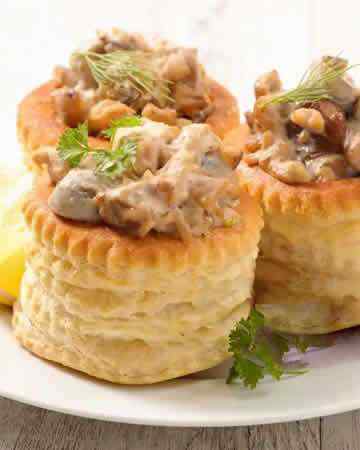 The "bouchette à la reine" is an iconic dish of French gastronomy and is also deeply rooted in the Alsatian culinary tradition.
Made with a light and crispy puff pastry crust (vol-au-vent), the "bouchette à la reine" is traditionally filled with a of simmered chicken and veal coated in a smooth and creamy sauce, garnished with mushrooms and poultry dumplings. A true feast, the "bouchette à la reine" is a comforting dish that is pleasant to share with family on festive days. In Alsace, it is customary to accompany these royal bites with Alsatian noodles (nüdle) and a glass of Alsatian white wine , of course. But what is the origin of this dish and why does it trigger such fervor in Alsace? The royal destiny of Alsatian queen's bites
The recipe for Bouchons à la Reine was created in Versailles, far from Alsace, in the time of Louis XV. The wife of the King of France, Queen Marie Leszczynska, asked her pastry chef Nicolas Stohrer to create a savoury pastry; the reason was apparently to create an aphrodisiac dish to regain the King's good graces. But in this Versailles story, Alsace is actually not so far away, since Nicolas Stohrer is . . . Alsatian. This talented pastry chef was born in a small village in the north of Alsace in 1706. And from the age of 14, he learned his trade in the kitchens of the former King of Poland Stanislas Leszczynski, dethroned and exiled to Wissembourg. Nicolas Stohrer's destiny for Bouchées à la reine began in 1725, when Stanislas Leszczynski married his daughter, Princess Marie Leszczynski, to Louis XV; Nicolas Stohrer then found himself some time later pastry chef to the Queen and honoured her request by creating these delicious bites. It must be said that our brilliant pastry chef is not new to this, since Nicolas Stohrer is also the creator of the very famous rum baba. This daring brioche soaked in a rum syrup was invented during his time spent in Alsace.
Get out your apron and indulge in the delicious and refined recipe for Alsatian Queen's Bouchons, an ideal dish to surprise your loved ones and create a warm meal with family or friends. The traditional Alsatian recipe contains meat and sweetbreads.
Filling:
veal sweetbread, uncooked (500 g)
2 chicken breasts, cooked, cut into very small pieces (~ 1 cm cubes) (500 g)
8 cups homemade chicken stock
1 pkg button mushrooms (250 g)
1 tsp. olive oil, or butter
1 pinch sea salt
Sauce Suprême:
6 Tbsp. + 2 Tbsp. butter
6 Tbsp. tapioca starch or cornstarch
2 Tbsp. coconut cream
2 egg yolks or 2 Tbsp. tapioca starch or cornstarch
1 Tbsp. lemon juice, freshly squeezed
2 Tbsp. Riesling or Madeira
½ tsp. sea salt
¼ tsp. black pepper, freshly ground
⅛ tsp. Espelette pepper, optional
For the Sweetbreads:
Place the sweetbreads in a medium saucepan and cover with cold, salted water. Bring to a boil and let them boil for 4 minutes. Strain the sweetbreads and rinse in cold water. Wipe out the saucepan (or wastefully use another) and add the sweetbreads along with the 8 cups of chicken stock for the filling. Keep the sweetbreads submerged with a plate or bowl or a saucepan lid that’s smaller than the pan you’re using and bring the saucepan to a boil. Reduce the heat and simmer for 1 hour. Remove the sweetbreads with a slotted spoon. Pour the stock through a fine mesh sieve and reserve it for later.
For the Mushrooms:
Clean the mushrooms and cut them into bitesize pieces (~ 4-8 pieces per mushroom, depending on the size). Heat a large skillet or saucepan with the olive oil and sprinkle the mushrooms with a pinch of salt. Cook for 15 minutes over medium-low heat, stirring frequently to evaporate the water. You’re sweating the mushrooms, not searing them. When done, remove the skillet from the heat.
For the Sauce and Assembly:
Melt the 6 Tbsp. butter in a medium saucepan over medium heat. Add the 6 Tbsp. tapioca starch or cornstarch to make a blonde roux, whisking constantly so the flour doesn’t brown. Cook for 3-4 minutes. Set aside to cool.
Peel the sweetbreads by removing the stringy and bits and veins. Place the small chunks of sweetbreads in a large bowl and taste and add salt if necessary. If your chicken stock didn’t contain salt, you might need up to a ¼ tsp. or so. Add the cooked chicken breast (add a tiny bit of salt to the chicken breast if necessary too) and the mushrooms to the large bowl.
If your vol-au-vent pastries are frozen, follow your pkg directions to reheat them in the oven. Otherwise, heat your fresh pastries gently in a 200°F (95°C) oven to warm them.
Cut down through the top of the pastry to make a hole. Or slice off the top mound of the pastry. Return the pastries to oven to keep warm.
Measure 6 cups of the chicken stock you used to simmer the sweetbreads (add water or stock to reach 6 cups if necessary) and pour into a saucepan. Bring to a boil. When boiling, pour the stock over the roux and whisk until no lumps remain. Cook for about 2-4 minutes over medium heat, until thick, whisking gently but constantly. Remove from the heat and keep covered.
In a small bowl, whisk together the coconut cream and egg yolks. Whisk in a tbsp or so of the thickened stock to temper the yolks, then whisk the yolks and coconut cream mixture back into the saucepan. The sauce shouldn’t be boiling, so the yolks shouldn’t scramble. Whisk in the remaining 2 Tbsp. butter in very small pieces, along with the lemon juice and Riesling (you can also add the Riesling to the 6 cups of chicken stock before adding it to the roux above, if you want to cook off the alcohol. Taste and add more lemon if necessary.
Season with the salt, pepper and Espelette pepper and taste to adjust the seasoning. Add the sweetbreads, chicken and mushrooms and stir to combine.
Scoop the filling into the pastries and top with the cylinder of pastry or the entire top half, according to how you cut them.
Serve immediately, with Riesling.
Makes 12 servings.
Cook's Notes:
In 1902, chef Auguste Escoffier listed sixteen recipes of appetizers of different appellations, shapes and garnishes, including the bouchée à la reine. Among its different recipes, you can find:
- Bouchée Bouquetière: Made from a vegetable brunoise.
- Bouchée Diane: Made with game meat.
- Bouchée Grand Duc: Made with asparagus tips and truffles.
- Bouchée Montglas: Made with foie gras and mushrooms.
- Bouchée Nantua: Made from crayfish tails and Nantua sauce.
- Bouchée à la Victoria: Made from a mixture of lobster and truffles in a lobster sauce.
- Bouchée Hollandaise: Made with salmon and hollandaise sauce topped with poached oysters.