Sausage and Sauerkraut (Slovenian Kranjska Klobasa)
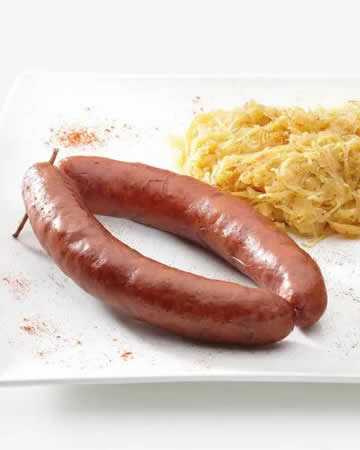 Kranjska klobasa literally means 'sausage from the Kranjska (Carniola) region.' It is an authentic Slovene product which has gained worldwide fame and popularity. Read on to find out more about Slovenia's most iconic sausage. Kranjska klobasa gained 'Protected Geographical Indication' status in 2015, meaning that a sausage can only be called 'Kranjska Klobasa' if it is produced in the Carniola region of Slovenia. There are also strict rules about the ingredients of the sausage:
'The Carniolan sausage contains at least 75-80% pork (aside from bacon), and at most 20% bacon. It may contain as much as 5% water, the sea salt from Sečovlje salt pans, little garlic, sodium nitrite and black pepper. No other ingredients are permitted. The meat must be cut in small pieces 10-13 mm and bacon 8-10 mm. The filling is stuffed into pork intestine with a diameter of 32-36 mm. They are formed in pairs of 12-16 cm (4.7-6.3") lengths and a weight of 180-220 g. Pairs are linked together with a wooden skewer. The sausages are hot smoked and heat-cured at about 70°C (158°F).'
Although it has counterparts in Austria, Germany and Croatia, and it is similar to the Polish Kielbasa, there is only one true Kranjska Klobasa. Its first mention in a Slovenian cookbook is from 1912, in the sixth edition of Slovenska kuharica (Slovene Cookbook) by Felicita Kalinšek.
Slovenian carniolian sausage (kranjska klobasa) is one of the most popular pork sausages in Slovenia, where lightly smoked, semi-dried sausages hold sway. Kranjska is traditionally smoked, but it can be left unsmoked and cooked fresh. The sausage apparently originated in Kranjska, a town in the mountainous Carniola region of northwest Slovenia, close to the Austrian and Italian borders. If you plan to cold smoke this sausage, you will need to add saltpeter or nitrates. If you plan to eat it fresh, you can skip this step. Consult a sausage-making book if you plan to smoke.
The Carniolan sausage (Kranjska klobasa) represents a Slovene culinary specialty that can be produced by no more than 13 Slovene producers that have obtained a certificate for its production. As a traditional food product it is protected by geographical indication in the country of origin and represents a symbol of cultural heritage that Slovenes are justifiably proud of.
Made using the finest pork and bacon with added sodium nitrite and seasoned solely with garlic and pepper, the Carniolan sausage is held together with a wooden skewer. The sausage is a reddish brown colour on the surface and bears a faint scent of smoke; in cross-section, the meat is pinkish red, while the bacon is a creamy white colour and not dissolved. The texture is taut, crunchy and juicy, with a full aroma that is characteristic of desalinated, specifically seasoned and smoked pork.
The Carniolan sausage originates from the times of the Austro-Hungarian monarchy and it was named after the province of Carniola which was, from the 15th century on, the central province in the territory of Slovenia and the only completely Slovenian region. The earliest mention of Carniolian sausage in German is found in Katarina Prato's renowned cookbook Süddeutsche Küche (South German Cooking, 1896), describing the manner of cooking the sausage. The oldest recipe for preparation of Carniolian sausage was published in 1912 in the sixth edition of "Slovenska kuharica" ("Slovene Cookbook)" by Felicita Kalinšek. Chroniclers of old Ljubljana mention the Carniolan as a part of menus at important and gala events.
The name of this sausage is, without a doubt, one of Slovenia's most widely and internationally recognisable names in gastronomy. Emigrating Slovenians took the sausage with them out into the world, making it famous worldwide. In the German-speaking world, the Carniolan sausage is known as "Krainer Wurst", while the English-speaking world knows it as "kransky sausage".
2 pairs Carnolian sausage
sauerkraut (500 g)
4 whole black peppercorns
1 pinch ground red paprika
2 cloves garlic
Season the sauerkraut with paprika, pepper, and garlic. Mix well.
Place the sauerkraut and sausages onto the perforated baking tray.