Legumes
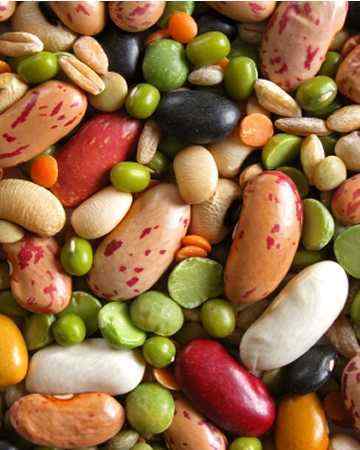 There are two types of legumes: mature and immature. Mature legumes are the dried seeds found inside pods that hang from the stems of certain plants. They are excellent sources of fibre (approximately 15 g/cup), rich in protein, and low in fat…Green beans and peas, commonly referred to as vegetables, are actually immature legumes because they are harvested before maturing on the plant.”
Well known legumes include alfalfa, clover, peas, beans, lentils, lupins, and peanuts (a peanut is a legume whose pod does not split open on its own).
A serving is 3 heaped tablespoons of beans. Remember, beans and pulses count as a serving of your daily vegetable requirements, but only as 1 portion, no matter how many you eat.
Nutritional benefits:
- Excellent source of protein.
- Good source fiber.
- Low in fat.
- Most varieties provide half our folate requirements.
- A good source of phosphorus, potassium, iron, zinc, calcium, and selenium.
- Contain Thiamin (B1), Riboflavin (B2), Niacin (B3), B5 and B6.
- Rich in antioxidants.
- Low Glycemic Index.
Below are a list of the nutrient highlights from some of the more commonly consumed bean varieties:
Red beans – top antioxidant bean containing more antioxidants than blueberries when compared gram-per-gram. Reds are also the top bean source of iron.
Kidney beans – second ranking antioxidant bean on the USDA’s list, and are also a top fibre source.
Black-eyed beans – these beans contain more calcium than any other bean, as well as being a source of folate and magnesium.
Black beans – in addition to ranking among the best antioxidant bean sources, black beans are the top bean source of magnesium.
Pinto beans – the top bean source of selenium, they are also ranked higher than the blueberry in their antioxidant power.