Asian Noodles
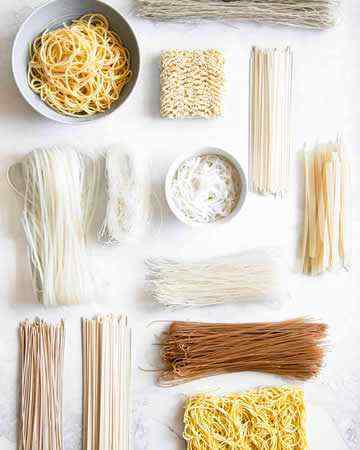 Chinese Egg Noodles:
Chinese egg noodles, also known as egg noodles, are timeless Asian noodles composed of wheat flour, water, and eggs. You can find egg noodles shaped into both thick and thin strands. Chinese egg noodles are beloved for their springy, chewy consistency. They are the staple ingredient in classic Chinese meals like chow mein, wonton soup, and lo mein. Some retailers cut corners and use food coloring to tint their noodles instead of eggs, so check ingredient labels to confirm you’re getting authentic egg noodles. Chinese egg noodles are distinct from the German egg noodle pasta known as spaetzle. Irregularly shaped and short, spaetzle is usually made with semolina flour, milk, and eggs. Spaetzle has a consistency reminiscent of a dumpling. In contrast, classic Chinese egg noodles are long, thin, and uniform. They are either round or flat and provide a springy, chewy texture. You cannot use these two distinct ingredients interchangeably.
Chow Mein:
The term is a combination of Cantonese/Hakka word for noodles "mein" (Chinese: 面; pinyin: Miàn) and French word for "fried". It was likely introduced in Mauritius by Chinese immigrants who mostly came from the Southeast part of China (mostly from the Cantonese regions) at the end of the 19th century. There are two main types of chow mein: steamed chow mein and crispy chow mein. To make steamed chow mein, chefs flash fry the egg noodles before tossing them with the rest of the ingredients and coating them in a light sauce. For crispy chow mein, chefs press the noodles flat while frying them. The chow mein dish you’ll find on most Chinese food menus was created by Chinese Americans. It evolved from an authentic dish known as ch’ao mien, aka “stir-fried noodles”. In American Chinese cuisine, chow mein is known as a specific dish made with egg noodles, meat, and vegetables bathed in a dark, thick, soy-based sauce.
Glass Noodles:
Glass noodles are transparent strands of starch derived from various tubers and beans. For the most part, they're tasteless and used as a conduit for flavour - dressed with spicy chili sauce or a robust sesame oil dressing. Cellophane noodles, or fensi, sometimes called glass noodles, are a type of transparent noodle made from starch (such as mung bean starch, potato starch, sweet potato starch, tapioca, or canna starch) and water. A stabilizer such as chitosan (or alum, illegal in some jurisdictions) may also be used. They are generally sold in dried form, soaked to reconstitute, then used in soups, stir-fried dishes, or spring rolls. They are called "cellophane noodles" or "glass noodles" because of their cellophane- or glass-like transparency when cooked. Cellophane noodles should not be confused with rice vermicelli, which are made from rice and are white in color rather than clear (after cooking in water).
Lo Mein:
While lo mein has changed over time, especially in the United States, the history of lo mein can actually be traced back over 2,000 years. Not only are the noodles used especially because they hold sauce easily and don't break apart in water, but they also have a spiritual meaning as well. They are often served during celebrations to honor a long and prosperous life. Lo mein is made with fresh, thick egg noodles, vegetables like bok choy, bean sprouts, and cabbage, and, oftentimes, beef, chicken, pork, or shrimp. American lo mein is different from Chinese lo mein. American lo mein consists of stir fried noodles with a thick soy-based sauce, vegetables, and meat or seafood. Cantonese lo mein has a thinner sauce that is stirred into the noodles, which are topped with wontons or brisket.
Ramen Noodles:
The dish has its origins in China, where it was introduced to Japan in the 19th century. The first known instance of ramen in Japan occurred in 1859, when the Chinese ambassador to Japan, Zeng Gongliang, presented the dish to the Japanese Emperor. Ramen is a popular Japanese dish that consists of Chinese-style wheat noodles served in a meat or fish-based broth, often flavored with soy sauce or miso, and topped with ingredients such as sliced pork, dried seaweed, and green onions. The dish has its origins in China, where it was introduced to Japan in the 19th century.
Rice Noodles:
You can loosely categorize Asian rice noodles under the Cantonese word fun or fen. Most Asian rice noodles are made from simple recipes of rice flour and water. From 5 cm long and 5 mm wide silver needle noodles to inch-wide chow fun noodles, Asian rice noodles come in all shapes and sizes. Rice noodles are the staple of many famous dishes like Singapore noodles, pho, and pad Thai. The same basic recipe is used to make rice paper for Vietnamese summer rolls.
Soba Noodles:
Soba noodles are Japanese noodles made with buckwheat flour and water (soba is the Japanese word for buckwheat). Many varieties use a percentage of whole wheat flour to make the noodles sturdier. Pure buckwheat soba is called ju-wari soba, and 80% buckwheat soba is known as hachi-wari soba. For authentic, high-quality soba noodles, check the label and make sure they have at least 70-80% buckwheat flour. Soba noodles are higher in protein and fiber than other types of Asian noodles. People use them in hot noodle dishes, cold noodle salads, and brothy noodle soups. Soba noodles are an easy and delicious way to accommodate gluten-free patrons, just make sure the noodles you’re using are 100% buckwheat (ju-wari soba).
Somen Noodles:
Somen noodles are wispy (less than 0.05 mm in diameter), pale, Japanese wheat noodles made from superfine wheat flour, salt, and water. After it’s hand-stretched into thin strips, somen noodle dough is coated in vegetable oil to prevent over-air-drying. Due to their thread-like consistency, you can cook somen noodles in under 3 minutes in boiling water; because the noodles contain salt, don’t salt the water before boiling them. Once cooked, rinse the somen in cold water to remove the oil. Summers in Japan are sweltering, and slurping cold somen noodles is a popular way to cool down. Cold somen noodles are dipped in umami-rich tsuyu sauce made by combining soy sauce, rice wine, sake, dried kelp, and dried bonito flakes. Many restaurants create an interactive serving experience known as nagashi somen. Invented after World War II, restaurants serve nagashi somen by dropping somen noodle clusters into a chute of running water. Patrons scoop the somen clusters out of the water with chopsticks as they float down, and then dunk them in a sauce. Somen noodles are enjoyed in hot soups and stir-fries during the colder months.
Udon Noodles:
Udon is a Japanese wheat-based noodle with a dense, chewy texture and little flavor. There are regional varieties that range in thickness, smoothness, and width. Udon has a signature white color no matter its regional rendition. You can purchase fresh or dried udon noodles to suit your recipe and storage needs. Dried udon noodles typically resemble fettuccine in shape and size. Fresh udon noodles often have rounder, plumper shapes. However, niche regions cut their udon into unique shapes. For example, in Aomori and Iwate Prefecture, they cut udon noodles into a signature triangle shape before adding them to mugi kakke soup. In the Tochigi region, they fold udon noodles into an ear shape for mimi udon soup. Mimi udon is a staple of New Year celebrations in the Senba region.
Vermicelli Noodles:
The term vermicelli encompasses a broad category of thin Asian noodles. The noodle must have a diameter of less than 0.06 inches (1.5 mm) to be classified as vermicelli. The most popular type of Asian vermicelli noodle is rice vermicelli. Rice vermicelli noodles are known as bee hoon in Hokkien Chinese, mai fun in Cantonese Chinese, wunsen in Thai, kya zan in Burmese, and bun in Vietnamese. Since vermicelli designates size, not ingredients, you'll encounter different types of vermicelli noodles dominating regional and national sales landscapes. In Vietnam, vermicelli noodles are the same as angel hair pasta. In China, you’ll find wheat vermicelli (misua) and various mung bean vermicelli noodles. Thailand is famous for its mung bean vermicelli, pad woon sen.